Showing posts with label randy quaid. Show all posts

Monday, November 19, 2012

Midnight Express (1978)


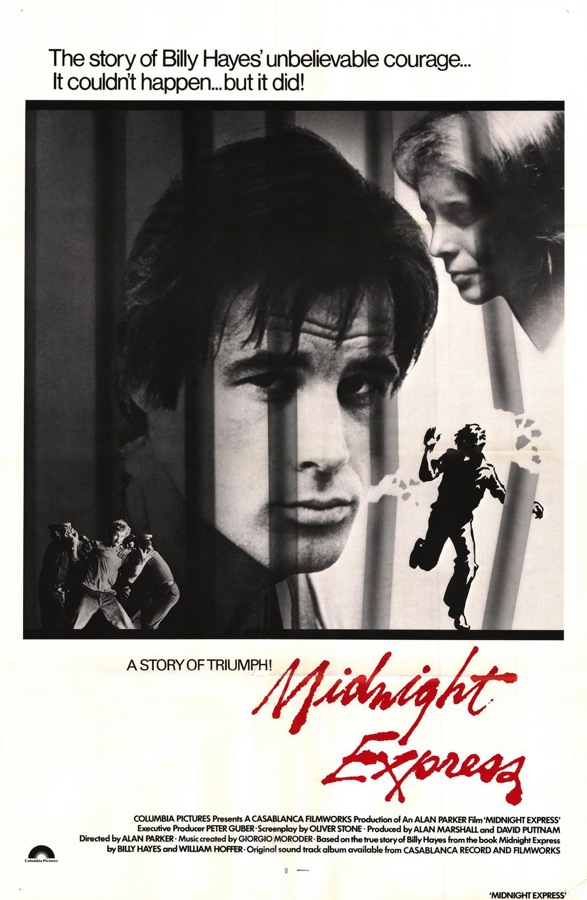
          The hard-hitting 1978 prison drama Midnight Express shares dubious qualities with another acclaimed film of the same year, Michael Cimino’s Vietnam saga The Deer Hunter. Both pictures feature unflinching depictions of inhumane treatment during incarceration, and both pictures are bullshit. In the case of Cimino’s movie, the famous Russian roulette scene used to depict the savagery of the Viet Cong had no basis in reality. Similarly, the most brutal sequences in Midnight Express are fabrications, even though Midnight Express was directly adapted from a book by Billy Hayes, the unfortunate young man whose odyssey in a Turkish prison is depicted in the movie.
          So, while Midnight Express is unquestionably arresting (and sometimes riveting), the movie has a distasteful undercurrent. It’s as if the film’s producers, together with screenwriter Oliver Stone and director Alan Parker, felt Hayes’ real-life travails weren’t sufficiently harrowing, which is nonsense. Therefore, it’s impossible not to wonder at the filmmakers’ agenda—was the point of goosing the content simply to make Midnight Express more exciting, or was something else involved, since nearly every Turk portrayed in the movie is a sadistic monster?
          Anyway, the story begins when Billy (Brad Davis), a cocky young American, straps two kilos of hash to his body before departing for the Istanbul airport. He’s caught with the drugs and thrown into a prison straight out of the Middle Ages, where physical abuse and rape are rampant. While ineffectual forces including Billy’s family and the U.S. consulate try to arrange Billy’s release, Billy makes friends in jail. His pals include hotheaded American Jimmy (Randy Quaid), who’s forever formulating escape plans; drug-addled Englishman Max (John Hurt), who knows secrets about the prison’s layout; and Erich (Norbert Weisser), a European with whom Billy forms a quasi-romantic bond. Meanwhile, Billy suffers the torments of grotesque jailers including sleazy trustee Rifki (Paolo Bonacelli) and vile head guard Hamidou (Paul L. Smith).
          Midnight Expressis torture porn made before that term was coined, because the film’s “entertainment value” comes from watching how much abuse Billy can endure. There’s an old-fashioned escape flick built into the picture’s DNA, of course, since the real Billy did indeed flee Turkish incarceration, but Parker and Stone seem more preoccupied with cataloguing horrors than in truly developing Billy’s characterization. Make no mistake, Midnight Express is an expertly rendered movie, with Stone’s script racing forward at a relentless speed while Parker creates grimly beautiful tableaux and composer Giorgio Moroder adds otherworldly textures through his Oscar-winning electronic score. The acting is also quite good, with Davis using every bit of his limited skillset while slicker actors including Hurt and Quaid offer subtler work for balance.
          But particularly when the movie slips into hard-to-watch scenes that spring from the filmmakers’ imagination, like a vicious moment in which Billy rips the tongue from another man’s mouth, it’s hard to discern authorial intention. Is this a thriller or a horror movie? And if it’s a cautionary tale drawn from life, why so much fakery? No matter its peculiar contours, however, Midnight Expressis highly memorable, as seen by one of its oddest echoes in the pop-culture universe—the scene in Airplane!(1980) during which a creepy pilot asks a young boy, “Joey, have you ever been in a Turkish prison?”

Midnight Express: GROOVY

Monday, July 16, 2012

Bound for Glory (1976)


          A beautifully made biopic with a few peculiar flaws, Bound for Glory represented yet another artistic high point for editor-turned-director Hal Ashby, whose ’70s output was as eclectic as it was impressive. This time, Ashby tackled the life story of pioneering American folksinger Woody Guthrie, whose enduring anthem “This Land Is Your Land” reflected his humanistic fascination with the downtrodden people he met during his vagabond adventures circa the Great Depression. Perfectly timed to tap into counterculture themes of reappraising priorities and questioning authority, Bound for Glory could easily have become a vanilla celebration of an iconic singer. Instead, it’s a rougher piece, demonstrating the strange conflict between Guthrie’s devotion to “the people” and his inability to fulfill familial obligations.
          The story begins in small-town Texas, with Woody (David Carradine) working as a freelance sign painter even though his real passion is playing music (he moonlights as a honky-tonk band’s guitarist). After one day too many without making a living wage, Woody skips out on his wife (Melinda Dillon) and becomes a hobo, stealing rides in the cargo cars of westbound trains as he makes his way toward the promised land of Southern California. Along the way, Woody sees enough deprivation and hardscrabble dignity to inspire a lifetime’s worth of original songs, and he finds himself drawn to the plight of the working men who are oppressed by callous business owners.
          Once in California, Woody is radicalized through his friendships with a fruit picker (Randy Quaid) and a union-organizing country singer (Ronny Cox). Picking up a guitar again after a long musical drought, Woody starts writing incendiary rabble-rousers. Then, after he’s hired to perform on the radio, he stumbles into an existential crisis when he’s forced to choose between integrity and a steady paycheck. The willingness on the filmmakers’ part to display Guthrie’s unattractive qualities gives Bound for Glory gravitas, complicating our idea of what Guthrie represents.
          This storytelling choice also gives Carradine the most multidimensional role of his career. He seizes the opportunity with a vibrant performance, crooning and philosophizing his way to an earthy incarnation of Guthrie’s troubadour spirit. Ashby surrounds Carradine and the rest of the strong cast with wonderfully evocative physical details, from the antiseptic milieu of recording studios to the heartbreaking ugliness of labor camps. Capturing all of these rich visuals is cinematographer Haskell Wexler, a diehard lefty who actually knew the real Guthrie back in the day; Wexler’s graceful camera movements and naturalistic lighting make Bound for Glory look like classic Depression-era photographs come to life.
          That said, Bound for Glory has strange shortcomings. Ashby bizarrely cast Dillon in two roles (she also plays a country singer who performs on the radio with Guthrie), and the ending isn’t particularly satisfying. One gets the impression Ashby couldn’t decide whether Guthrie was a heel or a hero, or both. But if the worst that can be said about a movie is that it embraces ambiguity, is that really much of a criticism?

Bound for Glory: GROOVY

Sunday, June 17, 2012

The Last Detail (1973)


          Jack Nicholson’s post-Easy Rider ascension to Hollywood’s A-list continued with The Last Detail, a crowd-pleasing road movie of sorts dominated by the raunchy Navy sailor whom Nicholson portrays with manic intensity. Written by Robert Towne from Darryl Ponicsan’s novel, and directed by the peerless humanist Hal Ashby, The Last Detail begins when enlisted men Buddusky (Nicholson) and Mulhall (Otis Young) get assigned to a demeaning task: They’re to escort a sailor named Meadows (Randy Quaid), who has been sentenced to eight years in jail for petty theft, across several states so he can commence his incarceration.
          Buddusky is a heavy-drinking troublemaker who peppers nearly every sentence with some variation of the word fuck, and Mulhall is a savvy African-American whose strategy for survival is flying below The Man’s radar. Buddusky convinces Mulhall to drag out their transport duty so they can pocket extra per-diem money, and once they meet Meadows, both men become sympathetic to the kid’s pathetic circumstances. A simple-minded stooge whose real crime was pissing off a superior officer, Meadows is so green that he’s never had booze, cigarettes, or sex. Buddusky decides to ensure Meadows experiences all three before hitting the brig, so the trio’s journey becomes a hell-raising odyssey.
          Some of the episodes are exactly what one might expect, like a brawl with a group of Marines, but others exude pure early-’70s quirkiness. The sailors meet a hippie chick who meditates with Far East chanting, so Meadows picks up the habit, and the sailors make a pit stop at Meadows’ home to discover the bleak reality he left behind when he joined the Navy. The Last Detail walks a fine line between comedy and drama, often pivoting instantaneously from raucous to somber and back again. While Ashby’s masterful control of tone anchors the storytelling, the picture rises to an even higher level on the strength of the performances.
          Quaid works the weird gentle-giant vibe that characterized many of his early roles, and it’s to his great credit that Meadows keeps surprising us right through to the final scene. As for Nicholson, his flamboyant turn in The Last Detail cemented his cinematic persona. And while he’s probably over the top in many respects, exaggerating his character’s volatility almost to the point of seeming insane, excess seems like an appropriate acting choice since Buddusky’s supposed to represent the male animal cut loose from decorum and propriety. (Young is fine, by the way, but his character is so underdeveloped that he’s regularly eclipsed by his costars.)
          The Last Detail isn’t perfect, given its weakness for clichés like the hooker with the heart of gold (Carol Kane plays this thankless role with a blend of cynicism and sweetness). Nonetheless, by the time the movie reaches its downbeat finale, Ashby and his collaborators have delivered a potent statement about the limitations that bureaucracies—and, really societies in general—place upon individuality.

The Last Detail: RIGHT ON