Showing posts with label right on. Show all posts

Tuesday, August 20, 2013

The War at Home (1979)


          A great example of the microcosm revealing the macrocosm, this insightful documentary examines antiwar demonstrations that erupted in and around the college town of Madison, Wisconsin, throughout the Vietnam War. In so doing, the film speaks to the larger issues that divided the entire nation during that fraught era. Filled with amazing archival footage—it seems as if every key event in the Madison peace movement was caught on camera—the picture is neatly divided into sections depicting specific years, so the narrative stretches from the earliest outcries in the mid-’60s to a violent revolt that shook the Madison community in the early ’70s. Right from the beginning of the picture, poignant moments abound. During a public hearing in the mid-’60s, for instance, a housewife named Louise Smalley testifies to local officials that she’s aghast by the notion of American troops dropping napalm on Vietnamese villages: “I try to teach my children the value of individual human worth, and I don’t want this destroyed by my country.”
          Just as that remark summarizes conscientious objections to the war, another comment symbolizes why so many college students mobilized—a student laments that the escalation of hostilities means middle-class kids will be subject to the draft, “not just poor kids.” Ouch. To the great credit of producers Glenn Silber (who also directed) and Barry Alexander Brown, The War at Home never seems judgmental of the implied elitist stance behind such remarks; rather, the film makes a compelling argument that the draft became a social equalizer, uniting potential draftees against the military-industrial complex. As a banner that’s shown onscreen reads, “To be against the war and do nothing is irresponsible.”
          It’s fascinating, then, to learn about the actions that people in Madison actually took. Some demonstrations seem pointless, almost to the extreme of being counter-productive, like heckling Teddy Kennedy during a 1966 campus appearance, while others are more purposeful, such as an SDS rally against Dow Chemical’s practice of on-campus recruiting. (Dow made napalm.) The filmmakers wisely keep their focus local, spreading the view to the larger national antiwar milieu only when appropriate—one bit describes how protesters from Wisconsin traveled to the infamous 1968 Democratic National Convention in Chicago. Similarly, the filmmakers largely eschew celebrities of the counterculture era. Even though the soundtrack features the requisite mix of Buffalo Springfield and Dylan, et cetera, hipster poet Allen Ginsberg is the only famous figure featured in an original interview. (Presidents Ford and Nixon, among other political notables, appear only in archival footage.)
          The War at Home culminates with vivid commentary from participants in a fatal campus bombing that represented a misguided attempt to derail on-campus military research. One of the convicted bombers, Karlton Armstrong, appears on-camera to explain his motivations, and then, in a bracing moment, Armstrong’s Greatest Generation father acknowledges how successfully antiwar activists were in bringing ugly realities to light. “They were telling the truth,” the father says. “We weren’t listening.”

The War at Home: RIGHT ON

Monday, August 12, 2013

Serpico (1973)


          Serpicooccupies such a significant place in film history that it’s difficult to discuss the film without reaching for superlatives so grandiose they lack real meaning. Among other things, Serpicois one of the greatest police movies ever made, Al Pacino’s leading performance stands among the finest accomplishments in ’70s screen acting, and Sidney Lumet’s meticulous direction demonstrates why every other subsequent filmmaker telling a New York-based crime story owes him a huge stylistic debt. Furthermore, the story—which was drawn from a famous real-life saga—perfectly encapsulates the ambivalent attitude Americans had toward cops and criminals in the ’70s. The fact that Serpico is essential cinema on myriad levels creates a challenge when trying to articulate its strengths and weaknesses—the strengths are familiar to most movie fans because the picture has been seen so widely, and the weaknesses don’t matter all that much. Nonetheless, any survey of ’70s cinema is absurdly incomplete without Serpico, so here goes.
          Pacino, in the full bloom of his early-’70s breakout period, brings all of his intellectualized Method intensity to the role of Frank Serpico, a real-life NYPD detective who became a controversial figure by testifying publicly about widespread police corruption; this adaptation of Peter Maas’ best-selling book portrays the hero as an everyman with high principles who finds it harder and harder to survive in an environment rife with officially sanctioned illegality. The picture begins with Serpico’s early days as a uniformed beat cop, when he alienates coworkers by refusing to accept protection money and by refusing to pinch cash that’s taken from crooks. As Serpico’s career continues, he evolves into a longhaired detective adept at undercover work, earning a steady stream of commendations and promotions for his bravery and investigative skill. Alas, Serpico’s rise coincides with a cancerous spread of police corruption, so his unwillingness to play dirty provokes widespread enmity. This culminates with a showdown that the real Serpico claims was an assassination attempt engineered by bad cops who were afraid that Serpico was going to blow the lid on corruption. And, indeed, the finale of the story, as in real life, is Serpico’s public testimony.
          The narrative is fantastically interesting from start to finish, and Pacino’s investment in his work is unquestionable—he’s a live wire in every scene. By the time the actor fidgets and struts through undercover scenes while he’s hidden behind long hair, a shaggy beard, and a floppy hat, his performance has reached the level of incarnation, because the emotional and physical reality Pacino creates by occupying space in a naturalistic way is utterly persuasive. Furthermore, Lumet captures the gritty rhythms of New York life so perfectly that much of Serpicofeels like a documentary. If there’s a noteworthy flaw to Serpico, it’s that Lumet and Pacino focus too closely on the details of the main character’s journey through the shadowy world of the NYPD. With the movie covering such a large stretch of time and including so many incidents, supporting characters inevitably seem incidental and interchangeable. As noted earlier, however, criticizing Serpico is a fool’s game, because one could easily counter-argue that the personal nature of Serpico is exactly what makes the film uniquely powerful. (After all, the story’s about one man against the world.) FYI, the movie’s success inspired a short-lived 1976-1977 TV series starring David Birney, though the deeper influence of Serpico can be seen in countless subsequent movies that attempted, with varying degrees of success, to imitate the film’s hyper-realistic texture.

Serpico: RIGHT ON

Monday, August 5, 2013

Hearts and Minds (1974)


          Years before Michael Moore started using the documentary form to launch broadside attacks against the political right wing, lefty producer Bert Schneider backed the creation of Hearts and Minds, director Peter Davis’ scalding examination of the Vietnam War from a multiplicity of perspectives. The Academy Award-winning doc is unapologetically polemical, because even though supporters of America’s involvement in Vietnam are given room to speak in the movie, they damn themselves with the ignorance of their statements. For instance, the jaw-dropping climax of the picture features General William Westmoreland, supreme commander of U.S. forces in Vietnam, claiming that “life is cheap” to Asians—even as Davis cuts to heartbreaking footage of the funeral for a South Vietnamese soldier. In unforgettable images, the soldier’s young son wails in agony while the soldier’s wife tries to climb into her husband’s grave.
          Obviously, Davis moves far beyond journalism with these types of rhetorical choices, so it’s best to approach Hearts and Minds not as an objective overview of the war but rather as an essential record of why so many people were against the war. Davis makes his points by presenting several distinctive individuals and then juxtaposing their perspectives. The first major player is Lt. George Coker, a clean-cut Jersey boy shown receiving a hero’s welcome after his release from a long internment as a P.O.W. During this opening scene (and elsewhere throughout the movie), Coker echoes Westmoreland’s dehumanizing attitude, referring to enemy combatants as “gooks.” Meanwhile, ex-pilot Capt. Randy Floyd, a wheelchair-bound longhair, openly weeps when trying to imagine how Vietnamese parents must have felt when the napalm bombs he dropped from his plane killed their children.
          Employing montage with great dexterity, Davis forms a collage of archival footage and new material, essentially distilling the debate about the war into an intense 112-minute discourse. On one extreme are former government officials and soldiers who rehash the old “domino theory” justifications; on the other extreme are anguished vets trying to grasp the severity of their deeds and their injuries. In between these extremes are key figures such as Daniel Ellsberg. The famed whistleblower whose illegal release of “The Pentagon Papers” radically changed the American public’s attitude toward the war, Ellsberg methodically explains how his discoveries changed hisattitudes. Like many others in the picture, he describes a gradual radicalization informed by mounting evidence that the war was not only unwinnable but fundamentally wrong—a political maneuver rather than a humanitarian intervention.
          One could argue that Davis overreaches during scenes in which he tries to identify the essential characteristics of the American soul that generate warmongering aggression; the merging of a rough high-school football game with a Lyndon Johnson speech about how Americans refuse to lose crosses the line into editorializing. But when Davis’ technique is true—which is the case throughout most of Hearts and Minds—he hits targets with incredible impact. The parade of interviews with physically and psychologically damaged veterans underscores how many young American lives were needlessly ruined by the war, and Davis’ footage of ordinary Vietnamese citizens describing how they ravaged by the war is enough to make any supporter of the conflict feel shameful. It’s probably impossible for contemporary viewers to imagine how powerful this material must have been during its original release, when all of these divisive issues were at the forefront of the national conversation, but Hearts and Minds has lost none of its ability to indict, inform, and infuriate.

Hearts and Minds: RIGHT ON

Tuesday, July 30, 2013

Harold and Maude (1971)


          Today, Harold and Maude is so widely regarded as one of the quintessential New Hollywood films that it’s surprising to learn the movie didn’t have an easy path to immortality—especially since the early life of the project seemed charmed. Writer and co-producer Colin Higgins developed the project during his graduate studies at UCLA’s film school and won a major prize for the script. Then, while working as a pool cleaner in L.A. to stay solvent, Higgins met the film’s other producer, Mildred Lewis. The pair tried to set up the project with Higgins directing, but Paramount nixed that plan and hired editor-turned-filmmaker Hal Ashby. Good move. In addition to hitting just the right mix of satire and sweetness, Ashby shot the picture on such a modest budget that the story reached theaters with its darkness and humanism intact.
          Yet Harold and Maude did not catch on during its original release; rather, it took years of home-video exhibition, theatrical reissues, and TV broadcasts for the movie to find its well-deserved status as a minor classic. That said, it’s not difficult to see why the film alienates as many people as it enchants. The premise is perverse, the humor is morbid, and the May-December romance at the heart of the story skirts the limits of good taste. After all, the actors playing the lovers in the movie’s title—Bud Cort (Harold) and Ruth Gordon (Maude)—were in their 20s and 70s, respectively, at the time of filming.
          Higgins’ bold script begins by introducing Harold Chasen, a rich kid so bored with the trappings of everyday life that he spends most of his energy staging outrageous suicide scenes for the kinky thrill of shocking his mother, Mrs. Chasen (Vivian Pickles). Since Harold never actually kills himself, however, it’s unclear whether his activities represent a genuine cry for help or just bizarre frivolity. Undaunted, Mrs. Chasen tries to match Harold with various potential brides, but Harold’s eerie theatrics spook all of them. Meanwhile, Harold amuses himself by visiting funerals, which brings him into contact with Maude Chardin, who also digs watching final farewells to the deceased. Maude is as free and open as Harold is repressed and quiet, so as they spend time together, Maude teaches Harold surprising lessons about making the most of every day; she’s also the only person who encourages Harold to embrace his oddness.
          The evolution of this relationship involves a series of touching revelations and surprises that won’t be spoiled here, but suffice to say that Harold and Maude has boundless integrity—the film is never less than true to its offbeat self, which is, of course, why the picture has become a source of inspiration for generations of independent-minded filmmakers. Each of the major elements in the movie approaches a kind of poetry, from Cort’s hangdog quirkiness to Gordon’s ebullient outrageousness, while Ashby consistently handles the material with sensitivity and style.
          The storytelling is a bit on the schematic side, and some of Harold’s suicide scenes are absurdly grandiose, but the soul of this movie is so utterly unique that expecting it to meet normal expectations is foolhardy. Especially with the jubilant soundtrack of Cat Stevens songs giving the piece a gentle heartbeat, Harold and Maude easily ranks among the most unconventional love stories ever filmed. It is also, not unimportantly, a perfect snapshot of the historical moment when mainstream Hollywood studios let young filmmakers run wild so long as they kept costs low. Harold and Maude isn’t perfect, but learning to accept the imperfections of life—no matter how horrific they might be—is a key component of the picture’s inspirational theme.

Harold and Maude: RIGHT ON

Tuesday, July 9, 2013

The Candidate (1972)


          “Our lives are more and more determined by forces that overwhelm the individual,” remarks Senatorial candidate Bill McKay (Robert Redford) at one point in The Candidate. The same can be said of McKay’s life, because over the course of this remarkable movie, the idealistic young activist gets swallowed by the machine that sells politicians to the American public. And keep in mind this sobering film was made two decades before the emergence of the Internet as a key factor in campaigns, so the realities to which it speaks have only become more troubling in the ensuing years. The wild part, of course, is that The Candidate isn’t a pure drama—it’s got a strong thread of comedy, because the filmmakers zeroed in on the absurdity of modern American politics. This is mainstream cinema of the highest order, blending lively entertainment and important themes into a unique viewing experience.
          The Candidate was written by Jeremy Larner, a speechwriter for Eugene McCarthy’s 1968 presidential campaign and, incidentally, the author of the book and screenplay for the eccentric 1971 drama Drive, He Said. Larner netted a Best Original Screenplay Oscar for The Candidate—although, inexplicably, he’s never written another movie—and his work meshes beautifully with that of his two plugged-in collaborators, director Michael Ritchie and star Robert Redford. Together, the team present the fictional McKay as a keeper of the Kennedy flame, an unapologetic liberal concerned with the troubles of minorities and the underclass. He’s blessed and cursed with unique political gifts, not only because he’s articulate and handsome but also because he’s the son of a legendary Senator, John J. McKay (Melvyn Douglas).
          When the story begins, Bill is happily involved with community activism and legal aid for the poor. He’s approached by ambitious campaign manger Marvin Lucas (Peter Boyle), who envisions Bill as an ideal opponent for slick Republican incumbent Crocker Jarmon (Don Porter). Naïvely (or cunningly) accepting Marvin’s line that a Senatorial campaign can be used to air Bill’s favorite issues, Bill agrees to run, although he’s told there’s little chance of actually winning. Then, as the campaign gains momentum, Bill’s idealism suffers the death of a thousand cuts when he makes compromises and softens his rhetoric into noncommittal generalities. The magnificent tension of the story arises from the question of whether Bill genuinely regrets the changes he’s making. As he succumbs to power and temptation, does Bill retain his inherent goodness, or does he willingly accede to “forces that overwhelm the individual”?
          Director Ritchie, who previously collaborated with Redford on Downhill Racer (1969), delivers some of his career-best work here, orchestrating complex scenes that simultaneously explore multiple dynamics, and his use of montage to simulate the excitement and pageantry of political events is impressive. The filmmakers also benefit from outstanding performances across the board. Yet it’s the subtlety of The Candidate that impresses the most, from the way Larner’s script evokes the fraught relationships between Bill and the people in his life to the way Redford communicates tiny nuances as they pass through his character’s mind.
          The Candidate runs a bit long at 110 minutes, and the picture could have benefited from a few more jokes to arrive at a more consistent tone. The movie is also, to be frank, a bit on the clinical side. However, these quibbles are insignificant in the face of how many things this truly great movie gets right. The Candidate is without question among the handful of truly essential films ever made about American politics, and it’s a career milestone for everyone involved.

The Candidate: RIGHT ON

Thursday, June 13, 2013

Barry Lyndon (1975)


          Slow, somber, and subtle, Stanley Kubrick’s three-hour historical drama Barry Lyndon, adapted from an 1844 novel by William Makepeace Thackeray, isn’t just one of the most unusual films of the 1970s—it is, in many ways, one of the most unusual films ever released by a major Hollywood studio. Arty and meditative from its first frame to its last, the picture is more of a cerebral exercise than an entertainment experience—envision a serious of gorgeous paintings accompanied by mesmerizing classical music and a wry narration track that contextualizes onscreen events, and you’ll come close to imagining what it’s like to watch Barry Lyndon. Even the film’s principal actors, Ryan O’Neal and Marisa Berenson, are featured as objects, their beautiful faces and figures used as blank slates onto which Kubrick projects his (and Thackeray’s) timeless themes of gamesmanship and greed. By reducing the importance of his actors to visual impact, Kubrick amplifies that Barry Lyndon is auteur filmmaking in the purest sense—even though the writer/director/producer didn’t generate the underlying material, he orchestrates every miniscule detail. (There’s a reason the movie took a reported 300 days to shoot, an eternity compared to normal production schedules.)
          Set throughout Europe in the middle-to-late 1700s, the story follows Irishman Redmond Barry (O’Neal) as he seeks his fortune. The synchronicity between Kubrick’s dry humor and Thackeray’s narrative becomes evident during an early scene featuring a highwayman. The robber stops Barry on a remote path in a forest, then steals Barry’s horse and money, but the whole exchange is conducted with the high language and perfect manners of gentlemen. Courtly criminality—could there be a better metaphor with which to communicate Kubrick’s cynical worldview? After being stripped of his humble resources, Barry transitions to a series of military adventures, but he eventually flees the military and bewitches a fabulously wealthy Countess, Lady Lyndon (Berenson). The minor obstacle of her husband is quickly dispatched when Barry’s brazen play for Lady Lyndon’s affections causes the husband to die of a coronary. Barry installs himself as the man’s replacement, but Barry’s social climb commences a new series of travails.
          Even though the film sprawls across three hours and moves at a stately pace, Barry Lyndon is hypnotic. Working with the genius cameraman John Alcott, Kubrick designs one beguiling visual after another, using deft tricks to create verisimilitude suggestive of the story’s era—most of the shots are static (and when they’re not, the camera moves are generally gradual and understated). Further, in the film’s most talked-about flourish, Kubrick and Alcott employ specially designed lenses to shoot nighttime interior scenes with only candlelight for illumination. Every sensation that meets the eye in Barry Lyndon casts a spell, from the spectacular Old Europe locations to the ornate costumes and hairstyles; better still, Kubrick merges images, music, and narration with symphonic precision. Whether the movie actually packs an emotional punch is a subjective matter—as is the larger question of whether such a story needs to pack an emotional punch—but the consummate artistry of the endeavor is undeniable. Whatever its shortcomings, not the least of which is O’Neal’s beautifully vacuous presence in the title role, Barry Lyndon captures moods and sensations virtually no other film has before or since.

Barry Lyndon: RIGHT ON

Monday, June 10, 2013

Brian’s Song (1971)


          From the time of its release until, arguably, the arrival of Field of Dreams (1991), the iconic TV movie Brian’s Songenjoyed an enviable status as the ultimate male-oriented tearjerker, combining the bittersweet tropes of the melodrama genre with the macho textures of sports cinema. Yet it would be wrong to dismiss Brian’s Song as a cheap exercise in audience manipulation—even though the film is too brief and schematic to dig particularly deep into the lives of its characters, Brian’s Song is a credible drama distinguished by a terrific leading performance and solid supporting turns. In fact, much of the picture’s power stems from the presence of James Caan in the title role, because at the time he made Brian’s Song, Caan was bursting with so much ambition and talent that his imminent ascendance to big-screen stardom was inevitable; all it took was an incendiary supporting performance in The Godfather, released a few months later, to complete Caan’s transformation from up-and-comer to household name.
          Based on pro football player Gale Sayers’ memoir about his friendship with doomed fellow Chicago Bears running back Brian Piccolo, Brian’s Song is a sensitive exploration of camaraderie in the face of hardship. Adapted with restraint and taste by screenwriter William Blinn and director Buzz Kulik, the picture begins with the arrival of Gale (Billy Dee Williams) to a Bears training camp. He’s immediately razzed by fellow newbie Brian (Caan), but the two subsequently bond. Later, Brian provides stalwart support when racists resist African-American Gale’s integration into the team. The budding friendship deepens further once Bears coach George Halas (Jack Warden) breaks a color barrier by making Brian and Gale roommates during trips for away games, and one of the warmest scenes in Brian’s Song revolves around Brian’s inability to make racist remarks even when he’s trying to motivate Gale during the painful recovery from a leg injury.
          Brian’s Song gets heavy during its second half, after Brian is diagnosed with cancer.  Suffice to say that only the most hard-hearted viewer could possibly get through the picture’s final scenes without shedding a tear, because the aim of Brian’s Song isn’t to bludgeon audiences with the pointless tragedy of a young life cut short, but rather to invigorate audiences by celebrating a friendship that outlasted death. Caan hits one right note after another here, blending sensitivity and toughness in a manner that later became his signature. Williams, never the most dexterous performer, benefits from a characterization based on reticence, so when the cracks in his character’s emotional armor finally show, the moments count. Warden, who won an Emmy for his performance, provides the definition of reliable support, grounding the film in the harsh realities of professional sports while also conveying a strong sense of innate decency.

Brian’s Song: RIGHT ON

Wednesday, May 22, 2013

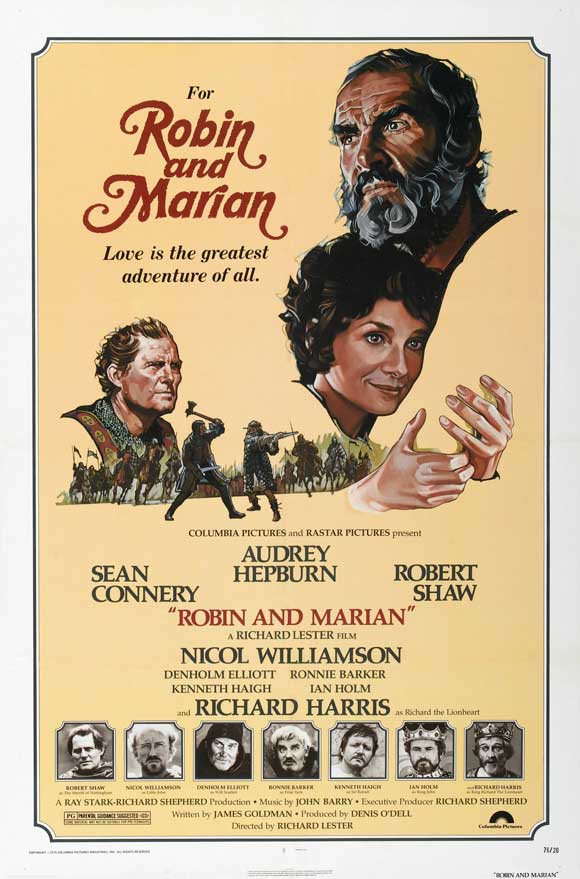
Robin and Marian (1976)


          If you’ve never heard of this romantic fantasy starring Sean Connery as Robin Hood and Audrey Hepburn as Maid Marian, there’s a good reason why—instead of being the light adventure you might expect, Robin and Marian is a tearjerker about aging. Penned by the great playwright/screenwriter James Goldman, best known for his masterpiece The Lion in Winter (which was produced on the stage in 1966 and adapted into a classic 1968 film), Robin and Marianoffers a unique blend of history, mythology, romanticism, and tragedy. From my perspective, this movie is a brilliant reimagining of a beloved fictional character, but chances are the downbeat storyline prevented Robin and Marian from reaching big audiences either during its original release or its home-video afterlife.
          Nonetheless, the movie’s pedigree is singularly impressive. Robin and Marian was directed by Richard Lester, who made the amazing Musketeersmovies of the ’70s and knew how to view swashbuckler iconography through a modernist’s eye; the plaintive score was composed by five-time Oscar winner John Barry, maestro of the sweeping strings; and the film’s naturalistic cinematography was lensed by David Watkin, who shot the aforementioned Musketeers movies and brought the same level of persuasive historical realism to Robin and Marian. Plus, we haven’t even gotten to the supporting cast, which is one of the best ever assembled.
          The story begins in France, where a graying Robin (Connery) and his sidekick, Little John (Nicol Williamson), are soldiers for King Richard the Lion-Heart (Richard Harris). After defying a cruel order from the king, Robin and Little John briefly incur royal enmity—a twist that neatly affirms Robin’s commitment to moral justice over loyalty to any crown. Once extricated from that conundrum, Robin and Little John return to Sherwood Forest, only to discover that the nasty old Sheriff of Nottingham (Robert Shaw) is making trouble again. Meanwhile, Robin tracks down his estranged lover, Marian (Hepburn), who has become a nun. As the story unfolds, Robin falls into open combat with the Sheriff’s men and tries to rekindle his love affair with Marian.
          Goldman’s script cleverly defines Robin Hood as someone who either bravely faces conflict or recklessly instigates conflict, if not both. In so doing, Goldman underlines why a man like Robin expects a hero’s death—it’s the only fitting capstone for a hero’s life. Further, Goldman’s treatment of aging defines Robin and Marian as a grown-up fable; the movie is filled with funny/sad images like that of Robin and the Sheriff huffing and puffing through their climactic duel. Yet the graceful aspects of time’s passage become evident in quiet scenes between Robin and Marian—with the wisdom of age, the characters gain the sure knowledge that they are the loves of each other’s lives.
          Connery gives one of his finest performances, undercutting his 007 image by playing the role with a balding scalp and a thick gray beard. On a deeper level, the actor summons more emotional nuance here than in almost any other film. Hepburn, who ended an eight-year screen hiatus to appear in Robin and Marian, capitalizes on her screen persona to equally strong effect—seeing the dewy gamine of the ’60s replaced by the mature beauty of the ’70s is a bittersweet experience. She’s majestic here. And, of course, to say that Harris, Shaw, Williamson, and fellow supporting players Denholm Elliot and Ian Holm are all terrific should come as no surprise. Robin and Marian is not for everyone, with its occasionally flowery dialogue and perpetually grim subtext, but for this particular viewer (and, I hope, many others), it’s a high order of elgiac poetry.

Robin and Marian: RIGHT ON

Friday, May 17, 2013

The Jericho Mile (1979)


          Michael Mann didn’t just introduce himself to viewers with his first feature-length directing job. He dazzled them. Arresting, emotional, and smart from its first frame to its last, this made-for-TV drama delivers an unusual story with meticulous realism, showcasing Mann’s signature tropes of a hip visual style, deeply felt character work, and ingeniously integrated music. The picture also demonstrates why Mann is virtually peerless in his depiction of the criminal mind, because he doesn’t portray crooks as monsters—rather, he portrays them as self-aware professionals ruled by strict codes.
          Set inside a maximum-security prison, The Jericho Mile revolves around Larry Murphy (Peter Strauss), a lifer who obsessively runs “fast miles” every day in the prison courtyard. Isolated from all but a few fellow inmates, Larry lives inside himself; the exhilaration of athletic challenge give his existence meaning and structure. One afternoon, humanistic prison shrink Dr. Bill Janowski (Geoffrey Lewis) clocks Murphy and realizes how fast the man is moving, so he confers with Warden Earl Gulliver (Billy Green Bush). An innovative penologist, Gulliver realizes that nurturing Murphy’s talent might inspire other inmates to break the cycle of jailhouse profiteering and post-incarceration recidivism. Gulliver invites a nationally ranked running coach, Jerry Beloit (Ed Lauter), to observe and possibly train Murphy. After staging a race between Murphy and several professional runners, Beloit declares that Murphy has Olympic potential. Yet that’s only the surface of the story. Unfolding concurrent with Murphy’s surprising odyssey is a grim drama involving powerful inmate Dr. D (Brian Dennehy), who runs a jailhouse drug ring and gets into a hassle with Murphy, which inadvertently sparks a prison-wide racial conflict.
          Laced into all of this is a potent revelation of Murphy’s layers. We don’t learn about the nature of his original crime until we’ve already become invested in his journey, so Murphy emerges as a profoundly sympathetic character—we’re able to root for him with full awareness of what he’s done, and full awareness of his capacity for future violence. Presenting Murphy without apologies might, in fact, be the greatest accomplishment of this fine film, so it’s no surprise that Strauss took home an Emmy for his dimensional performance, or that Mann and co-writer Patrick J. Nolan shared an Emmy for the picture’s outstanding teleplay. Yet on many levels, The Jericho Mile is most impressive as a compendium of all the skills Mann had developed thus far as a writer-producer on episodic TV shows, and that he would continue to embellish in his extraordinary feature career. He uses editing and music to create vivacious rhythms; he shoots real locations and sets equally well to conjure an engrossing sense of place; and he guides actors toward naturalistic performances.
          Character players including Bush, Lauter, Lewis, and Roger E. Mosley do some of their career-best work here, imbuing their roles with lively individuality. Dennehy, still very early in his screen career, is animalistic and frightening, and Strauss achieves several moving moments by channeling a volatile combination of compassion and rage. (Strauss totally nails Mann’s trademark device of having criminals speak without contractions to avoid misunderstanding, so he seethes when delivering such lines as, “Man, I am into nothing! That is how I do my time!”) Plus, as he so often does, Mann pulls the whole movie together with an ingenious musical flourish, turning a Latin-ized version of the Rolling Stones’ “Sympathy for the Devil” into Murphy’s searing theme song.

The Jericho Mile: RIGHT ON

Wednesday, May 1, 2013

The Cowboys (1972)


          Although John Wayne’s actual cinematic swan song was The Shootist (1976), which depicts an aging gunfighter’s quest for death with dignity, the Duke’s earlier film The Cowboys is in many ways a richer closing statement about the themes Wayne spent decades exploring in Western movies. Instead of merely pondering the question of whether a man who lives by the gun must die by the gun—the poignant central theme of The Shootist—The Cowboys explores all the qualities, bad and good, that defined the Duke’s screen persona. His character, Wil Andersen, combines frontier values, heroic self-sacrifice, macho stoicism, and, of course, that most American of qualities: rugged individualism. The fact that Andersen’s journey inadvertently inspires a group of boys to become young men molded in Andersen’s honorable image perfectly echoes the manner in which Wayne’s characters inspired generations of moviegoers. So, whether you love or hate Wayne’s on- and off-screen politics, it’s easy to appreciate the elegance of this picture’s symbiosis between star and story.
          Based on a novel by William Dale Jennings and adapted for the screen by Jennings and the husband-and-wife duo Irving Ravetch and Harriet Frank Jr., The Cowboys tells a simple story about noble characters clashing with craven ones. In the beginning of the movie, rancher Andersen preps for a cattle drive until his crew abruptly quits to join the Gold Rush. In short order, Andersen finds himself interviewing an unlikely set of replacements—several schoolboys, some teens and some even younger. When the kids display unexpected determination, he agrees to hire them. However, word of available work also attracts a gaggle of varmints led by Asa Watts (Bruce Dern), whom Andersen quickly identifies as a dangerous type. Andersen refuses to hire Asa’s gang, and then sets off on the drive with the kids as his crew. A series of frontier adventures ensues, during which Andersen gruffly mentors the boys on what it takes to succeed in the cattle biz. Meanwhile, Asa’s nefarious gang trails the cowboys, eventually leading to an infamous showdown between Dern and Wayne—the climax of the duel won’t be spoiled here, but suffice to say one single moment helped cement Dern’s typecasting as a crazed villain.
          Although the storyline of The Cowboysis so schematic as to seem a bit like a fable, the piece works—mightily—because of immaculate craftsmanship and vivacious performances. Director Mark Rydell, himself a thespian, does a gorgeous job of blending different types of acting, so everything from Wayne’s stylization to Dern’s improvisation feels unified; Rydell also draws fine work from young performers including Robert Carradine, who made his screen debut in The Cowboys. (Grown-ups in the fine supporting cast include Roscoe Lee Browne, Colleen Dewhurst, and Slim Pickens.) Cinematographer Robert Surtees captures the rugged beauty of untarnished landscapes, while composer John Williams’ music strikes just the right balance of excitement and wistfulness. And if the movie’s a bit bloated at 131 minutes, so what? Thanks to its careful treatment of resonant themes, The Cowboysis arguably Wayne’s best film of the ’70s.

The Cowboys: RIGHT ON

Tuesday, April 2, 2013

The Great Waldo Pepper (1975)


          Director George Roy Hill was such a fervent airplane enthusiast that he persuaded two of his most acclaimed collaborators, screenwriter William Goldman and star Robert Redford, to join him in making this passion project celebrating the daredevils who flew biplanes at exhibitions across the country during the barnstorming era. (The trio’s previous joint venture, released in 1969, was a little something called Butch Cassidy and the Sundance Kid.) Set in the 1920s, the picture focuses on Waldo Pepper (Redford), a World War I veteran whose military service was unspectacular. Driven to prove he’s a world-class flyer, Pepper becomes a barnstormer, performing wild stunts for spectacle-hungry crowds that are equally thrilled by crashes and triumphs.
          During this early stretch of the film, when Pepper builds a friendship with fellow flyer Axel Olsson (Bo Svenson) and struggles through a fraught romance with Maude (Margot Kidder)—who hates the risks Waldo takes—Hill achieves two impressive storytelling feats. First and most obviously, he captures the joy of flight with terrific aerial photography. Secondly and more subtly, he captures the lonely quality of men who follow an inner call toward personal achievement. Redford is the perfect actor for communicating this notion; an iconoclast who has spent decades cultivating personal mystique, Redford understands self-definition.
          Considering that Hill could easily have translated his fascination with barnstorming into a lightweight adventure film—in addition to Butch Cassidy, he and Redford made the endearing 1973 romp The Sting (which was not written by Goldman), so frothy entertainment is undoubtedly what audiences expected from this particular paring of actor and star—it’s impressive that Hill elected to go so dark. In fact, some might argue he went too dark. Goldman has often told the story of how a preview audience turned on the movie during a shocking scene involving Pepper and a terrified, wing-walking stuntwoman (Susan Sarandon). Yet viewed beyond the context of its initial release, when audiences wanted Redford to play only golden gods, The Great Waldo Pepper is a nuanced and thoughtful film that unflinchingly depicts the costs of individualism.
          As the story progresses, for instance, Pepper endures a string of accidents that cost him his pilot’s license and force him to pursue work as a movie stuntman under an alias. Goldman’s writing excels in this last movement of the picture, since Goldman has often said the theme that touches him most is “stupid courage”—boldness in the face of certain doom. The Great Waldo Pepper isn’t a perfect picture, with some of its episodes connecting more strongly than others, but it’s a unique celebration of one filmmaker’s romantic visions, seen through the prism of a star and a writer who were eager to help their friend realize his dreams of soaring through the sky, cinematically speaking.

The Great Waldo Pepper: RIGHT ON

Sunday, March 10, 2013

Black Sunday (1977)


          Full disclosure: Even though I recognize its many flaws, I lovethis movie for its ambition, intelligence, and toughness—and especially for costar Bruce Dern’s searing performance. Black Sunday is bleak, long, and outlandish, but whenever I watch the picture, I perceive those qualities as strengths rather than weaknesses.
          Based on an early novel by Thomas Harris, who later created Hannibal Lecter and wrote the various books about the cannibalistic shrink’s exploits, Black Sunday is an old-school terrorism thriller. When a Palestinian extremist named Dahlia Iyad (Marthe Keller) surfaces on the radar of merciless Mossad agent David Kabakov (Robert Shaw), David methodically tracks her down to the U.S. and joins forces with an FBI agent, Sam Corley (Fritz Weaver), to identify her plan and stop her. It turns out Dahlia has recruited a PTSD-stricken Vietnam vet, American pilot Michael Lander (Dern), to fly the Goodyear Blimp into a Miami stadium during the Super Bowl, where Dahlia will activate explosives inside the blimp and send thousands of steel darts flying into the crowd.
          John Frankenheimer, a seasoned pro at tightly coiled action stories, directs the film in an expansive style, taking equal care with intimate scenes of Dahlia manipulating Michael’s fragile psyche and big-canvas action sequences. What makes Black Sunday unique, however, is its sensitive exploration of Michael’s mental state—despite being neither the film’s hero nor its villain, Michael is by far the picture’s most developed character, and this peculiar storytelling choice delivers fascinating results. As the story progresses, we learn that David (the Mossad agent) is a cold-blooded hunter for whom the ends justify the means. Dahlia, meanwhile, is a kind of psychic counterpoint to David, and the biggest distinction between them is Dahlia’s willingness to kill bystanders for dramatic effect. Therefore, the conflict between these characters is a draw, morally speaking.
          Caught between them, literally and metaphorically, is Michael, a haunted man who endured torture as a prisoner of war, only to return home to an ungrateful society. Even when Michael is carefully preparing explosives, he acts more like an artist than a potential mass murderer; we feel his suffocating angst and wish for him to escape Dahlia’s destructive influence. Dern soars in this movie, adding dimension upon dimension to a role that’s perfectly suited to his offbeat gifts.
          Keller is good, too, presenting a creepy sort of sociopathic sensuality, and Shaw, though regularly upstaged by Dern and Keller, has many vivid moments. His is not, however, a true leading man’s performance—his characterization is far too cruel for that. Adding greatly to the movie’s appeal is a robust score by John Williams, which jacks up the tension, and muscular cinematography by John A. Alonzo. Black Sunday goes overboard during the finale, during which the laws of physics take a beating and during which iffy special effects dull the film’s impact, but even with its goofy denouement, Black Sunday is a popcorn flick executed with a rare level of craftsmanship behind and in front of the camera.

Black Sunday: RIGHT ON

Wednesday, February 13, 2013

The Long Goodbye (1973)


          Even by the downbeat standards of the mid-’70s noir boom, The Long Goodbye is dark as hell, notwithstanding the film’s major subcurrent of bone-dry humor. Adapted from the 1953 Raymond Chandler novel featuring iconic fictional detective Philip Marlowe, the movie blends Chandler’s cynical worldview with that of director Robert Altman by updating the storyline to the modern era and inserting additional nihilistic violence. Yet The Long Goodbye is essentially a character study disguised as a murder mystery, because, as always, Altman is far more interested in the eccentricities of human behavior than in the mundane rhythms of straightforward plotting. And, indeed, the storyline is murky, albeit intentionally so; presumably, the idea was to make viewers feel as mystified about whodunit (and why) as Marlowe himself.
          In broad strokes, the storyline begins when Marlowe’s pal Terry Lennox (portrayed by former pro baseball player Jim Bouton) has the detective drive him from L.A. to Tijuana for unknown reasons. Returning home to L.A., Marlowe learns that Lennox’s wife is dead. Lennox is the principal suspect, so Marlowe gets busted as an accessory—until a report surfaces from Mexico that Lennox committed suicide. Meanwhile, Marlowe gets pulled into two other mysteries with unexpected connections to the Lennox situation. Marlowe’s asked to track down a missing author, and he’s harassed by a psychotic gangster who believes Marlowe knows the whereabouts of a suitcase full of loot.
          While The Long Goodbye unfolds in an extremely linear style compared to other Altman films of the period—this isn’t one of his big-canvas ensemble pictures—the director’s roaming eye serves the material well. After developing Marlowe as a loser who can’t even keep his housecat satisfied because he fails to buy the right cat food (an unsatisfied cat—how’s thatfor an impotence metaphor?), Altman drops Marlowe into a world of wealth and privilege by setting most of the detecting scenes inside the exclusive Malibu Colony. With his cheap suit and vintage car, Marlowe’s a walking anachronism as he rubs shoulders with rich narcissists like the runaway author, thundering alcoholic Roger Wade (Sterling Hayden), and Wade’s desperately lonely wife, Eileen (Nina Van Pallandt).
          Furthermore, Marlowe can only watch, helpless, as the gangster, Marty Augustine (played wonderfully by actor/director Mark Rydell), abuses his people—such as in a shocking scene involving Marty and his mistress. Altman illustrates that Marlowe’s pretty good at discovering facts simply through shoe-leather tenacity, but that he’s powerless to effect positive change in a world overrun by fucked-up people determined to hurt each other. The best moments of the movie are scalding, notably Hayden’s riveting scenes as a formidable man hobbled by liquor. And the scenes representing pure invention on the part of screenwriter Leigh Brackett, including the Augustine bits, are vicious. (Brackett, it should be noted, was one of the writers on the classic 1946 Marlowe mystery The Big Sleep, with Humphrey Bogart.)
          Gould is ingenious casting, because his sad-sack expressions and wise-ass remarks clearly define Marlowe as an outsider who’s been screwed over by life—thus subverting audience expectations of a super-capable sleuth—and Altman surrounds Gould with an eclectic supporting cast. (Watch for a cameo by David Carradine and an uncredited bit part by a pre-stardom Arnold Schwarzenegger.) Aided by the great cinematographer Vilmos Zsigmond, who literally probes the darkness of Los Angeles with grainy wide shots peering far into shadowy tableaux, Altman transforms Chandler’s book into a ballad of alienation.

The Long Goodbye: RIGHT ON

Sunday, February 3, 2013

The Longest Yard (1974)


          A great sports movie, a memorable comedy, and one of leading man Burt Reynolds’ best films, The Longest Yard is also a potent expression of anti-Establishment rage, channeling the tenor of its time through the unlikely prism of a prison picture about football. Directed by action master Robert Aldrich at his sharpest, the movie blends brutal gridiron violence with intense behind-bars clashes to create a pervasive vibe of us-vs.-them tension. The film’s humor emerges almost entirely from character and circumstance, and the script (by Albert S. Ruddy and Tracy Keenan Wynn) is filled with characters who are strangely believable even though many of them should seem absurd. The prison angle justifies the presence of extreme personalities, and the cast—which mostly comprises character actors and real-life athletes—relishes the story’s ample opportunities for super-sized moments.
          Reynolds stars as Paul “Wrecking” Crewe, a former pro quarterback whose career was tarnished by a point-shaving scandal. After a fight with his girlfriend, Paul gets drunk and instigates a police chase by driving recklessly. Then he’s thrown into a prison run by sports nut Warden Rudolph Hazen (Eddie Albert). Hazen has organized his guards into a football squad, and he expects Paul to coach the team while incarcerated. Paul refuses, so he’s put on backbreaking labor duty. Eventually, Paul makes a counter-proposal to Hazen, offering to train a team of inmates for an exhibition game against the guards. Although it’s understood that Hazen expects the guards to win, Paul inspires his fellow convicts by saying the game is a chance to pummel their oppressors. The plot goes through several twists past this point, and interesting relationships develop between Paul, the guards, and the inmates; Hazen’s scheme to exploit a convict ends up enflaming the resentment that festers inside the prison walls. And if none of this sounds particularly funny, rest assured The Longest Yard is filled with wicked humor, even as the storyline deftly integrates dramatic elements.
          The centerpiece of the movie is, of course, the big game, which stands alongside the football match in M*A*S*H (1970) as one of the funniest gridiron sequences in movie history. Reynolds thrives here, infusing his role with the sardonic attitude that distinguishes his best performances, and Hollywood veteran Albert makes a terrific villain by portraying a man whose greatest weakness is his arrogant reliance on power. Among the large supporting cast, standouts include James Hampton as Paul’s sidekick, Caretaker; Ed Lauter as the cruel coach of the guards’ team; and Bernadette Peters’ as Hazen’s va-va-voom secretary, who becomes sympathetic to Paul’s plight. Best of all is the film’s terrific climax, which perfectly crystallizes the complex textures of the storyline. The Longest Yard was loosely remade in 2001 as the Vinnie Jones movie Mean Machine, and directly remade in 2005, with Adam Sandler taking over the Reynolds role. Stick with the original.

The Longest Yard: RIGHT ON