Showing posts with label robert shaw. Show all posts

Tuesday, July 2, 2013

Young Winston (1972)


          It’s appropriate that the longest sequence in Young Winston takes place during the Boer War, because the movie is a bore. Restrained and respectful in the extreme, this adaptation of a memoir by the revered UK wartime leader Winston Churchill sprawls across 157 lugubrious minutes. Written for the screen and produced by the great Carl Foreman, with Richard Attenborough handling the direction, the film boasts impressive production values but an overly sterile narrative style.
          The most interesting thread of the movie relates to future politician Winston's fraught relationship with his father, forceful Member of Parliament Lord Randolph Churchill (Robert Shaw). During childhood, Winston struggles to earn his aloof father's attention, and during adulthood, Winston seeks revenge against the political establishment that bested his father. This is rich stuff, but Foreman and Attenborough approach the intense family material with the stuffiness of textbook authors. Another thread of the picture involves Winston's relationship with his American-born mother, Lady Churchill (Anne Bancroft). She represents an interesting collision between aggressive and passive impulses, but her complexities remain largely unexplored. The third and final major thread of the story—which gets the most screen time--involves Winston's military career. Alas, the filmmakers can't decide where they stand on Winston's conduct as an officer. Is he a hero willing to risk all for his country and himself (two entities he considers inextricably linked), or is he the glory-hound his detractors criticize him for being? Like so many questions that are raised by Young Winston, this one goes unanswered.
          Foreman integrated many of Churchill's own musings into the script, and those remarks are read in voiceover by star Simon Ward, performing a cartoonish impression of the real Churchill's distinctive speech pattern. Attenborough, who later found his groove as a director of critic-proof dramas about saintly characters—notably Gandhi (1982)—delivers acceptable work during the picture's big-canvas scenes, such as those depicting Winston's battlefield exploits circa the late 19th century and early 20th century. (It helps that the filmmaker shamelessly copies David Lean’s pictorial techniques.) Attenborough's filmmaking doesn't fare as well during close-quarters sequences. For instance, he relies on an ineffective device of filming just one side of long interview scenes while an unseen journalist peppers the interview subject with questions. These scenes drag on forever.
          Not all of Young Winston’s shortcomings should be blamed on Attenborough, however. Leading man Ward (who plays Winston as a young adult) lacks charisma and dynamism, which short-circuits the whole enterprise, and Foreman’s script features excruciating detail about the internecine processes of British government. (Even the long Boer War sequence, which portrays Winston's capture by enemy forces and subsequent daring escape, gets bogged down with narration explaining the political significance of Winston’s situation.) Unsurprisingly, Shaw gives the closest thing the picture has to a full-blooded performance. His appearance climaxes with a poignant scene of Lord Churchill succumbing to mental decay in the midst of a speech. But if the best scene in a two-and-a-half-hour biopic doesn't revolve around the protagonist, that’s a problem.

Young Winston: FUNKY

Monday, June 17, 2013

The Taking of Pelham One Two Three (1974)


          A clever and funny hostage picture with an offbeat setting and an even more offbeat protagonist, the 1974 version of The Taking of Pelham One Two Three is vastly superior to the 2009 remake starring John Travolta and Denzel Washington. Whereas the latter picture is frenetic and slick, Joseph Sargent’s ’70s version mixes expertly orchestrated suspense with amusingly grumpy Noo Yawk character flourishes. In fact, The Taking of Pelham One Two Three achieves that most difficult of balancing acts by intermingling danger and humor so that scenes are often jittery and droll at the same time. The title relates to the hijacking of an NYC subway train by a group of middle-aged terrorists whom we get to know by code names: Ice-blooded mastermind “Mr. Blue” (Robert Shaw), trigger-happy gunman “Mr. Grey” (Hector Elizondo), avuncular driver “Mr. Green” (Martin Balsam), and accomplice “Mr. Brown” (Earl Hindman). These four take over a train and communicate their demand for $1 million via radio to the New York Transit Authority, threatening to kill hostages on a regular basis if the city fails to meet a ransom deadline. This puts the crooks at odds with Lt. Zachary Garber (Walter Matthau), a sarcastic, seen-it-all cop with the Transit Authority’s police force.
          Many of the beats in this story, which was adapted from a novel by John Godey, are standard stuff for hostage pictures: The political machinations of the mayor as he contemplates paying the ransom; the revelation that one of the hostages is an undercover cop; the tricky games Garber plays to buy time; and so on. It’s the execution, however, that makes all the difference. The great playwright/screenwriter Peter Stone delivers Godey’s pulpy narrative with what can only be described as effervescence. While Stone ensures that violent scenes have genuine tension, he threads the script with dry one-liners and pithy dialogue exchanges. In particular, Stone does wonders with the radio conversations between Garber and “Mr. Blue”—the adversaries pick at each other like bickering spouses, a vibe underlined by the contrast between Matthau’s put-upon petulance and Shaw’s tightly contained rage. (Another of the film’s many effective running jokes involves Garber giving a tour of the Transit Authority’s facilities to visiting Japanese dignitaries on the day the hijacking happens; wait for the terrific punchline after watching Garber make a series of offensive remarks to his seemingly oblivious guests.)
          Sargent keeps his camerawork nimble, exploiting the atmosphere of gritty locations, and he benefits from the hard-edged imagery of master New York cinematographer Owen Roizman (The French Connection). Adding to the entertaining verisimilitude is a cavalcade of salty New York character actors: In addition to Balsam, Elizondo, and Matthau, the picture features Kenneth McMillan, Dick O’Neill, Doris Roberts, and Tony Roberts. Balsam and Elizondo are memorable as, respectively, a schmuck who gets involved in something he can’t handle and a psycho who gets off on carrying a gun. Best of all, of course, is the movie’s exciting final act, which features a series of unexpected climaxes stacked upon each other—the conclusion of The Taking of Pelham One Two Threemanages to pay off every subplot meticulously and satisfyingly.

The Taking of Pelham One Two Three: GROOVY

Wednesday, May 22, 2013

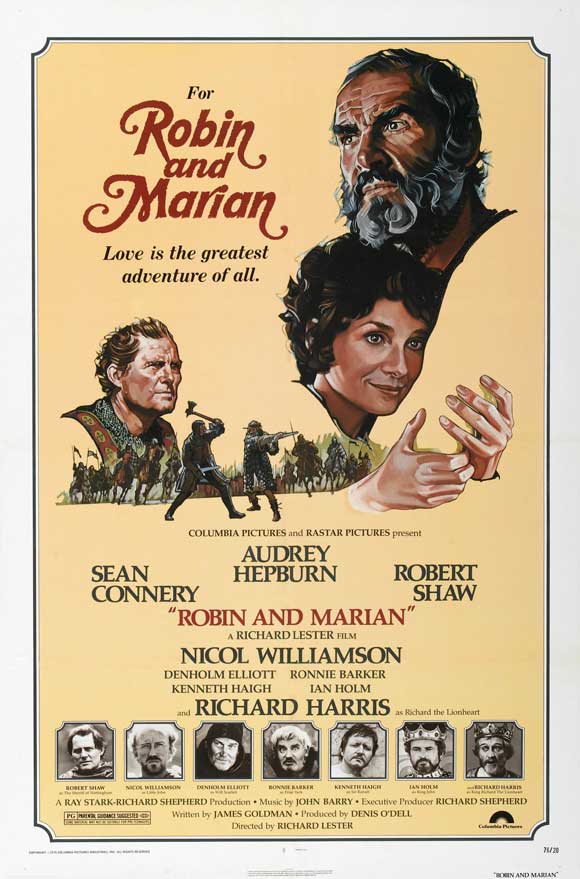
Robin and Marian (1976)


          If you’ve never heard of this romantic fantasy starring Sean Connery as Robin Hood and Audrey Hepburn as Maid Marian, there’s a good reason why—instead of being the light adventure you might expect, Robin and Marian is a tearjerker about aging. Penned by the great playwright/screenwriter James Goldman, best known for his masterpiece The Lion in Winter (which was produced on the stage in 1966 and adapted into a classic 1968 film), Robin and Marianoffers a unique blend of history, mythology, romanticism, and tragedy. From my perspective, this movie is a brilliant reimagining of a beloved fictional character, but chances are the downbeat storyline prevented Robin and Marian from reaching big audiences either during its original release or its home-video afterlife.
          Nonetheless, the movie’s pedigree is singularly impressive. Robin and Marian was directed by Richard Lester, who made the amazing Musketeersmovies of the ’70s and knew how to view swashbuckler iconography through a modernist’s eye; the plaintive score was composed by five-time Oscar winner John Barry, maestro of the sweeping strings; and the film’s naturalistic cinematography was lensed by David Watkin, who shot the aforementioned Musketeers movies and brought the same level of persuasive historical realism to Robin and Marian. Plus, we haven’t even gotten to the supporting cast, which is one of the best ever assembled.
          The story begins in France, where a graying Robin (Connery) and his sidekick, Little John (Nicol Williamson), are soldiers for King Richard the Lion-Heart (Richard Harris). After defying a cruel order from the king, Robin and Little John briefly incur royal enmity—a twist that neatly affirms Robin’s commitment to moral justice over loyalty to any crown. Once extricated from that conundrum, Robin and Little John return to Sherwood Forest, only to discover that the nasty old Sheriff of Nottingham (Robert Shaw) is making trouble again. Meanwhile, Robin tracks down his estranged lover, Marian (Hepburn), who has become a nun. As the story unfolds, Robin falls into open combat with the Sheriff’s men and tries to rekindle his love affair with Marian.
          Goldman’s script cleverly defines Robin Hood as someone who either bravely faces conflict or recklessly instigates conflict, if not both. In so doing, Goldman underlines why a man like Robin expects a hero’s death—it’s the only fitting capstone for a hero’s life. Further, Goldman’s treatment of aging defines Robin and Marian as a grown-up fable; the movie is filled with funny/sad images like that of Robin and the Sheriff huffing and puffing through their climactic duel. Yet the graceful aspects of time’s passage become evident in quiet scenes between Robin and Marian—with the wisdom of age, the characters gain the sure knowledge that they are the loves of each other’s lives.
          Connery gives one of his finest performances, undercutting his 007 image by playing the role with a balding scalp and a thick gray beard. On a deeper level, the actor summons more emotional nuance here than in almost any other film. Hepburn, who ended an eight-year screen hiatus to appear in Robin and Marian, capitalizes on her screen persona to equally strong effect—seeing the dewy gamine of the ’60s replaced by the mature beauty of the ’70s is a bittersweet experience. She’s majestic here. And, of course, to say that Harris, Shaw, Williamson, and fellow supporting players Denholm Elliot and Ian Holm are all terrific should come as no surprise. Robin and Marian is not for everyone, with its occasionally flowery dialogue and perpetually grim subtext, but for this particular viewer (and, I hope, many others), it’s a high order of elgiac poetry.

Robin and Marian: RIGHT ON

Thursday, April 4, 2013

The Man in the Glass Booth (1975)


          Although best known as an actor, for extensive work on the London stage and for Hollywood endeavors such as his spectacular performance as Captain Quint in Jaws(1975), the late Robert Shaw was also a novelist and playwright. His most famous literary endeavor was the 1967 novel The Man in the Glass Booth, which he adapted into a 1968 play of the same name. Set in modern-day New York, the story concerns Arthur Goldman, a wealthy Holocaust survivor who spends his days haranguing employees with outlandish opinions about Judaism even as he seems to teeter on the brink of a nervous breakdown. One day, Israeli secret agents break into his home and reveal that Goldman is actually a Nazi war criminal living under an assumed identity. Next, Goldman is illicitly extradited to the Middle East for prosecution. (During the court action, he’s placed in the titular glass booth for his own protection.) All through the trial, Goldman proudly wears his SS uniform and outrageously lectures the Israeli audience with justifications murdering Jews. The story ends with a bizarre twist that raises as many questions as it answers.
          Although the play of The Man in the Glass Booth was presented in New York with an acclaimed production directed by Harold Pinter and starring Donald Pleasance, changes were made after the piece was selected for production by the American Film Theatre, a short-lived production company that filmed plays for limited movie-theater exhibition. The project got a new director (Arthur Hiller), a new star (Maximilian Schell), and a new script (by Edward Anhalt). Shaw was sufficiently displeased with the alterations that he removed his name from the film’s credits. Setting aside the matter of fealty to its source material, the movie version of The Man in the Glass Boothis a strange experience. Hiller does an okay job of opening up cinematic potential, using intricate sets to create separate spaces and thereby divide long scenes into smaller sequences; similarly, he also employs close-ups to accentuate the weird rhythms of Goldman’s euphoric monologues.
          And if Hiller’s filming is lively, Schell’s performance is positively supercharged—though not necessarily in a good way. Flamboyant, loud, and sensual, Schell’s interpretation borders on camp. One can make a strong argument that Schell chews scenery in proper proportion to the way his character does, but it gets suffocating after a while to watch the actor cackle and gesticulate and scream. Still, many found his work impressive, since he got Golden Globe and Oscar nominations. The real challenge of The Man in the Glass Booth, however, relates to the story’s ending, which won’t be spoiled here—suffice to say, the denouement is such a surprise, and such a head-scratcher, that it retroactively colors every preceding scene. Nonetheless, The Man in the Glass Booth offers a unique combination of ideology, philosophy, provocation, and wit—so even at its most questionable, the movie is arresting and sophisticated.

The Man in the Glass Booth: GROOVY

Sunday, March 10, 2013

Black Sunday (1977)


          Full disclosure: Even though I recognize its many flaws, I lovethis movie for its ambition, intelligence, and toughness—and especially for costar Bruce Dern’s searing performance. Black Sunday is bleak, long, and outlandish, but whenever I watch the picture, I perceive those qualities as strengths rather than weaknesses.
          Based on an early novel by Thomas Harris, who later created Hannibal Lecter and wrote the various books about the cannibalistic shrink’s exploits, Black Sunday is an old-school terrorism thriller. When a Palestinian extremist named Dahlia Iyad (Marthe Keller) surfaces on the radar of merciless Mossad agent David Kabakov (Robert Shaw), David methodically tracks her down to the U.S. and joins forces with an FBI agent, Sam Corley (Fritz Weaver), to identify her plan and stop her. It turns out Dahlia has recruited a PTSD-stricken Vietnam vet, American pilot Michael Lander (Dern), to fly the Goodyear Blimp into a Miami stadium during the Super Bowl, where Dahlia will activate explosives inside the blimp and send thousands of steel darts flying into the crowd.
          John Frankenheimer, a seasoned pro at tightly coiled action stories, directs the film in an expansive style, taking equal care with intimate scenes of Dahlia manipulating Michael’s fragile psyche and big-canvas action sequences. What makes Black Sunday unique, however, is its sensitive exploration of Michael’s mental state—despite being neither the film’s hero nor its villain, Michael is by far the picture’s most developed character, and this peculiar storytelling choice delivers fascinating results. As the story progresses, we learn that David (the Mossad agent) is a cold-blooded hunter for whom the ends justify the means. Dahlia, meanwhile, is a kind of psychic counterpoint to David, and the biggest distinction between them is Dahlia’s willingness to kill bystanders for dramatic effect. Therefore, the conflict between these characters is a draw, morally speaking.
          Caught between them, literally and metaphorically, is Michael, a haunted man who endured torture as a prisoner of war, only to return home to an ungrateful society. Even when Michael is carefully preparing explosives, he acts more like an artist than a potential mass murderer; we feel his suffocating angst and wish for him to escape Dahlia’s destructive influence. Dern soars in this movie, adding dimension upon dimension to a role that’s perfectly suited to his offbeat gifts.
          Keller is good, too, presenting a creepy sort of sociopathic sensuality, and Shaw, though regularly upstaged by Dern and Keller, has many vivid moments. His is not, however, a true leading man’s performance—his characterization is far too cruel for that. Adding greatly to the movie’s appeal is a robust score by John Williams, which jacks up the tension, and muscular cinematography by John A. Alonzo. Black Sunday goes overboard during the finale, during which the laws of physics take a beating and during which iffy special effects dull the film’s impact, but even with its goofy denouement, Black Sunday is a popcorn flick executed with a rare level of craftsmanship behind and in front of the camera.

Black Sunday: RIGHT ON

Saturday, June 23, 2012

Swashbuckler (1976)


Two depressing facts emerge when one surveys actor Robert Shaw’s career following his breakout performance in Jaws (1975): Shaw’s days on this earth were numbered, so he only had three years in which to enjoy his newfound fame, and almost every post-Jaws movie in which he starred was terrible. Nonetheless, one gets the impression that Shaw had a blast play-acting in macho leading roles, so, for instance, he exudes contagious joie de vivre in this terrible pirate movie. On some metaphysical level, the possibility that Shaw had fun making Swashbucklercompensates for the lack of enjoyment viewers derive from watching the movie. On the plus side, Swashbuckler is a fairly lavish production about an 18th-century buccaneer battling a crazed tyrant in Jamaica. Additionally, even though director James Goldstone can’t come close to matching the lighthearted approach to swordfighting featured in Richard Lester’s Musketeer movies of the same era, at least Goldstone fills the screen with talented actors. Dressed in a silly costume of red tights and a flowing red blouse, Shaw presents a lusty copy of Errol Flynn’s patented derring-do, and he shares mildly amusing interplay with his cheerful second-in-command, played by James Earl Jones. (The cast also includes Beau Bridges, Geneviève Bujold, Geoffrey Holder, and a young Angelica Huston.) However, the material is so generic that copious screen time is wasted on clichés like peg-legged pirates brandishing their cutlasses and growling. Worse, Peter Boyle’s performance as Lord Durant, the aforementioned tyrant, is atrocious. Woefully miscast, his contemporary American patois seeping through the fruity period jargon he’s forced to spew, Boyle tries to enrich his characterization with perverse qualities, but he seems like he’s in a different movie than everyone else. Unfortunately, the movie he’s in isn’t any better than Swashbuckler.

Swashbuckler: LAME