Showing posts with label walter matthau. Show all posts

Sunday, August 25, 2013

Plaza Suite (1971) & California Suite (1978)


          During the ’70s, it seemed as if playwright/screenwriter Neil Simon was an industry rather an individual—every year except 1978, he unveiled a new play, and from 1970 to 1979 no fewer than 11 features were released with Simon credited as writer. When the man slept is a mystery. In fact, he even managed to crank out a quasi-sequel to one of his own hits. Plaza Suite premiered on Broadway in 1968 before hitting the big screen in 1971, and its follow-up, California Suite, debuted onstage in 1976 before becoming a movie in 1978. Neither project represents the apex of Simon’s artistry, but both are rewarding. The title of Plaza Suite is a pun, because the film comprises a “suite” of three mini-plays, each of which takes place within the same suite at the Plaza Hotel in New York City.
          In order of appearance, the vignettes concern a middle-aged couple breaking up when the husband’s infidelity is revealed; a tacky Hollywood producer inviting his childhood sweetheart, now married, to his room for a tryst; and another middle-aged couple going crazy when their adult daughter won’t leave the suite’s bathroom even though guests are waiting downstairs to watch her get married. The first sequence is a bittersweet dance, the second is bedroom farce with a touch of pathos, and the third is an explosion of silly slapstick. Plaza Suite grows more entertaining as it spirals toward its conclusion, finally achieving comedic liftoff during the third sequence, which is by far the most fully realized.
          Walter Matthau somewhat improbably plays the lead roles in all three sequences, and he’s terrific—chilly as the adulterous husband, smarmy as the producer, enraged as the would-be father of the bride. His primary costars are a poignant Maureen Stapleton in the first sequence, a delicately funny Barbara Harris in the second, and an entertainingly frazzled Lee Grant in the third. Plaza Suitedrags a bit, and it’s tough to get revved up for each new sequence, but the fun stuff outweighs everything else.
          California Suite wisely takes a different approach—although the play of California Suite featured four separate stories, in the style of Plaza Suite, the film version cross-cuts to create momentum. And while Matthau is back (in a new role), California Suite benefits from a larger cast and more use of exterior locations. The film is primarily set in the Beverly Hills Hotel, but Simon (who wrote the screenplays for both adaptations) includes many places beyond the hotel. One thread of the story involves a New York career woman (Jane Fonda) bickering with her estranged screenwriter husband (Alan Alda) over custody of their daughter. Another thread concerns a British actress  (Maggie Smith) in town for the Oscars, accompanied by her husband (Michael Caine), a gay man she wed in order to avoid gaining a reputation as a spinster. The silliest thread involves a Philadelphia businessman (Matthau) trying to keep his wife (Elaine May) from discovering the prostitute in their room. And the final thread depicts the deteriorating friendship between two Chicago doctors (Bill Cosby and Richard Pryor), who bicker their way through a catastrophe-filled vacation.
          Smith won an Oscar for California Suite, and her storyline benefits from the way Caine and Smith expertly volley bitchy dialogue. The Alda/Fonda scenes are more pedestrian, and they’re also the most stage-bound pieces of the movie; still, both actors attack their roles with vigor. Matthau’s vignettes are quite funny, with lots of goofy business about trying to hide the hooker behind curtains, under beds, and so forth. Plus, as they did in A New Leaf (1971), May and Matthau form a smooth comedy duo. Only the Cosby/Pryor scenes really underwhelm, not by any fault of the actors but because both men have such distinctive standup personas that it seems limiting to confine them within the light-comedy parameters of Simon’s style. Unlike its predecessor, California Suite eventually sputters—the funniest scenes occur well before the end.
          As a final note, it’s interesting to look at both pictures and see how two very different filmmakers approached the challenge of delivering Simon’s work to the screen. For Plaza Suite, Arthur Hiller simply added close-ups and camera movement to accentuate the rhythms of the stage production, and for California Suite, Herbert Ross took a more holistic path toward realizing the work as cinema. Yet in both cases, of course, Simon’s wordplay is king.

Plaza Suite: GROOVY
California Suite: GROOVY

Friday, August 9, 2013

Kotch (1971)


          Walter Matthau delivered a series of wonderfully entertaining performances in the ’70s, his rapscallion charm stemming from the ability to hide characters’ warmhearted souls behind a disagreeable persona. For much of the decade, watching Matthau play men who bitch and whine their way toward doing the right thing was a source of endless pleasure. To his credit, however, Matthau wasn’t averse to deviating from his signature style. For instance, Matthau took something of a leap with Kotch by playing not only an overtly nice character but also by playing a senior; after all, the actor was merely middle-aged at the time of filming. And while Matthau scored an Academy Award nomination for his trouble (eventually losing Best Actor to Gene Hackman’s star-making turn in The French Connection), one would be hard-pressed to describe Kotch as a seminal Matthau project. Kotch is forgettable and sentimental, so the picture’s only real claim to fame is that it was the only feature directed by actor Jack Lemmon, Matthau’s frequent onscreen sparring partner. Lemmon’s filmmaking seems competent, though it’s hard to tell how much of the picture’s craftsmanship sprang from Lemmon’s imagination and how much was the result of solid work by Lemmon’s experienced crew. The shortcomings of Kotch are not related to execution. Rather, they stems from the underlying material, because the story—which screenwriter John Paxton adapted from a novel by Katharine Topkins—simply isn’t very interesting.
          The movie’s narrative concerns Joseph Kotcher, a likeable old man living with his son’s family. “Kotch” is enamored of his very young grandson, Duncan, but Kotch’s daughter-in-law wants the old man relocated to a retirement home. In the film’s most poignant sequence, Kotch realizes he’s not wanted, so he hits the road in order to find a new living arrangement. Not long afterward, the film settles into a sitcom-style dynamic: Kotch befriends Erica (Deborah Winters), a young pregnant woman. Although the film avoids any suggestion of May-December romance, the relationship is predictable—Kotch needs someone to nurture, Erica needs a guardian, blah-blah-blah. (It’s also distracting that the still-vital Matthau spends the whole movie hidden behind glasses, old-age makeup, and a white wig.) Filmed with a lush glow and served on a bed of gooey music by Marvin Hamlisch, Kotch is pleasant enough to watch. Furthermore, it’s hard to criticize a story that celebrates compassion, tenderness, and the value of senior citizens. Alas, good intentions only go so far. Especially seeing as how bolder filmmakers working in the same era were able to generate such surprising senior-themed stories as Harry and Tonto(1974) and Going in Style (1979), the unthreatening narrative of Kotchseems bland beyond belief when compared those films. As a result, only Matthau’s innate charisma and the film’s upscale production values give Kotchany real distinction.

Kotch: FUNKY

Monday, June 17, 2013

The Taking of Pelham One Two Three (1974)


          A clever and funny hostage picture with an offbeat setting and an even more offbeat protagonist, the 1974 version of The Taking of Pelham One Two Three is vastly superior to the 2009 remake starring John Travolta and Denzel Washington. Whereas the latter picture is frenetic and slick, Joseph Sargent’s ’70s version mixes expertly orchestrated suspense with amusingly grumpy Noo Yawk character flourishes. In fact, The Taking of Pelham One Two Three achieves that most difficult of balancing acts by intermingling danger and humor so that scenes are often jittery and droll at the same time. The title relates to the hijacking of an NYC subway train by a group of middle-aged terrorists whom we get to know by code names: Ice-blooded mastermind “Mr. Blue” (Robert Shaw), trigger-happy gunman “Mr. Grey” (Hector Elizondo), avuncular driver “Mr. Green” (Martin Balsam), and accomplice “Mr. Brown” (Earl Hindman). These four take over a train and communicate their demand for $1 million via radio to the New York Transit Authority, threatening to kill hostages on a regular basis if the city fails to meet a ransom deadline. This puts the crooks at odds with Lt. Zachary Garber (Walter Matthau), a sarcastic, seen-it-all cop with the Transit Authority’s police force.
          Many of the beats in this story, which was adapted from a novel by John Godey, are standard stuff for hostage pictures: The political machinations of the mayor as he contemplates paying the ransom; the revelation that one of the hostages is an undercover cop; the tricky games Garber plays to buy time; and so on. It’s the execution, however, that makes all the difference. The great playwright/screenwriter Peter Stone delivers Godey’s pulpy narrative with what can only be described as effervescence. While Stone ensures that violent scenes have genuine tension, he threads the script with dry one-liners and pithy dialogue exchanges. In particular, Stone does wonders with the radio conversations between Garber and “Mr. Blue”—the adversaries pick at each other like bickering spouses, a vibe underlined by the contrast between Matthau’s put-upon petulance and Shaw’s tightly contained rage. (Another of the film’s many effective running jokes involves Garber giving a tour of the Transit Authority’s facilities to visiting Japanese dignitaries on the day the hijacking happens; wait for the terrific punchline after watching Garber make a series of offensive remarks to his seemingly oblivious guests.)
          Sargent keeps his camerawork nimble, exploiting the atmosphere of gritty locations, and he benefits from the hard-edged imagery of master New York cinematographer Owen Roizman (The French Connection). Adding to the entertaining verisimilitude is a cavalcade of salty New York character actors: In addition to Balsam, Elizondo, and Matthau, the picture features Kenneth McMillan, Dick O’Neill, Doris Roberts, and Tony Roberts. Balsam and Elizondo are memorable as, respectively, a schmuck who gets involved in something he can’t handle and a psycho who gets off on carrying a gun. Best of all, of course, is the movie’s exciting final act, which features a series of unexpected climaxes stacked upon each other—the conclusion of The Taking of Pelham One Two Threemanages to pay off every subplot meticulously and satisfyingly.

The Taking of Pelham One Two Three: GROOVY

Sunday, November 25, 2012

The Front Page (1974)


          Item No. 1: Vienna-born writer-director Billy Wilder made his name co-writing delightful screwball comedies such as 1941’s Ball of Fire. Item No. 2: Adapted from the 1928 Ben Hecht-Charles MacArthur stage play The Front Page, Howard Hawks’ 1940 film His Girl Friday is one of the unassailable classics of the screwball-comedy era. Item No. 3: If anyone had the qualifications to remake His Girl Friday, it was Wilder.
          Well, qualified or not, Wilder botched the job.
          One of the key elements of His Girl Friday (and great screwball comedies in general) was the clever use of euphemisms to slip outré material past censors. Wilder’s remake of The Front Page dumps the subtle approach in favor of tiresome vulgarity. Worse, Wilder’s remake ditches the best contrivance of His Girl Friday—Hawks’ movie flipped the gender of one of the play’s leading characters, transforming the original Hecht-MacArthur story about feuding frenemies into a crackling love story. Sure, Wilder had at his disposal two leading men with whom he’d achieved great results before, Jack Lemmon and Walter Matthau, but dropping the battle-of-the-sexes angle was a bad call.
          As in the original play (Wilder’s movie retains the Hecht-MacArthur setting of the late ’20s), the story concerns gruff newspaper editor Walter Burns (Matthau), who wants his star reporter, Hildy Johnson (Lemmon), to cover the impending execution of a political revolutionary. Alas, Hildy has picked this day to quit the journalism business and get married, so Walter unscrupulously manipulates events to keep Hildy working. Meanwhile, the revolutionary escapes and seeks refuge in the courthouse newsroom, so Hildy shifts from covering a story to hiding a fugitive.
          In any incarnation, the Hecht-MacArthur script is filled with wonderful zingers, but Wilder and frequent collaborator I.A.L. Diamond dilute their adaptation with pointlessly crude additions. For instance, journalists remind a hooker (Carol Burnett, miscast and terrible) that if she hits the streets for money, doing so will cause “a lotta wear and tear on your ass.” She replies with equal sophistication, calling them “shitheels.” Elsewhere, Hildy excoriates Walter by saying, “The only time you get it up is when you put the paper to bed,” and Walter says that if Hildy takes a job writing ad copy, he’ll be a “faggot.”
          One cannot impugn the film’s technical execution, since Wilder uses limited sets effectively and cinematographer Jordan Cronenweth gives the picture a fine polish; similarly, the Lemmon/Matthau bickering-buddies routine was among the smoothest in the business. But so what? All of this good effort was put in the service of a poorly conceived and totally unnecessary retread of material that, in at least two previous incarnations (the original stage play and the Hawks film), was already considered classic.

The Front Page: FUNKY

Thursday, July 26, 2012

Earthquake (1974)


          Pure junk that nonetheless provides abundant guilty pleasure, Earthquakewas a pinnacle of sorts for the disaster-movie genre. Executive producer Jennings Lang was recruited by Universal Pictures to copy the formula that Poseidon Adventure mastermind Irwin Allen had perfected at rival studio 20th-Century Fox, so Lang commissioned a thrill-a-minute script (co-written by Mario Puzo) and hired a large ensemble of mid-level actors. The resulting movie, as produced and directed by fading studio-era helmer Mark Robson, is a cheesefest replete with bad acting, horrible clothes, and ridiculous storylines. However, since those are exactly the kitschy qualities that fans of the disaster genre dig, Earthquake became a major hit, earning nearly $80 million despite costing only $7 million. Therefore, Earthquakerepresents the disaster genre in full bloom.
          While there’s not much point in discussing the actual plot—there’s a giant earthquake in L.A., in case you haven’t guessed—listing a few of the characters should give the flavor of the piece. Leading man Charlton Heston plays Stewart Graff, a businessman whose rich father-in-law, Sam Royce (Lorne Greene), offers him a company presidency in exchange for staying married to shrewish Remy Royce-Graff (Ava Gardner); meanwhile, Stewart is screwing around with a younger woman, Denise Marshall (Geneviève Bujold). Bullish police offer Lou Slade (George Kennedy, of course) spends most of the movie watching out for Rosa (Victoria Principal), a busty young woman who wears her hair in some sort of Latina Afro, because she’s mixed up with a motorcycle-riding daredevil (Richard Roundtree) and a psychotic stalker (Marjoe Gortner). Oh, and Walter Matthau plays a bizarre cameo as a drunk dressed in head-to-toe polyester, complete with a flaming-red pimp hat.
          Virtually every melodramatic cliché from ’70s cinema is represented somewhere in Earthquake, which treats seismic activity as a cosmic metaphor for the uncertainty of life. And by “metaphor,” I really mean “narrative contrivance,” because the script for Earthquake exists far below the level of literary aspiration; this movie’s idea of storytelling is stirring up trite conflict before adding tremors that kill people in exciting ways. However, some of the big-budget effects scenes are enjoyable in a tacky sort of way, and the histrionic nature of Heston’s and Kennedy’s acting keeps their scenes jacked up to an appropriately goofy level of intensity. Plus, during its most outrageous scenes—picture Roundtree performing Evel Knievel-style motorcycle stunts as Principal cheers him while wearing an undersized T-shirt that displays his logo across her ample bosom—Earthquakeembraces its low nature by providing shameless distraction.

Earthquake: FUNKY

Friday, May 11, 2012

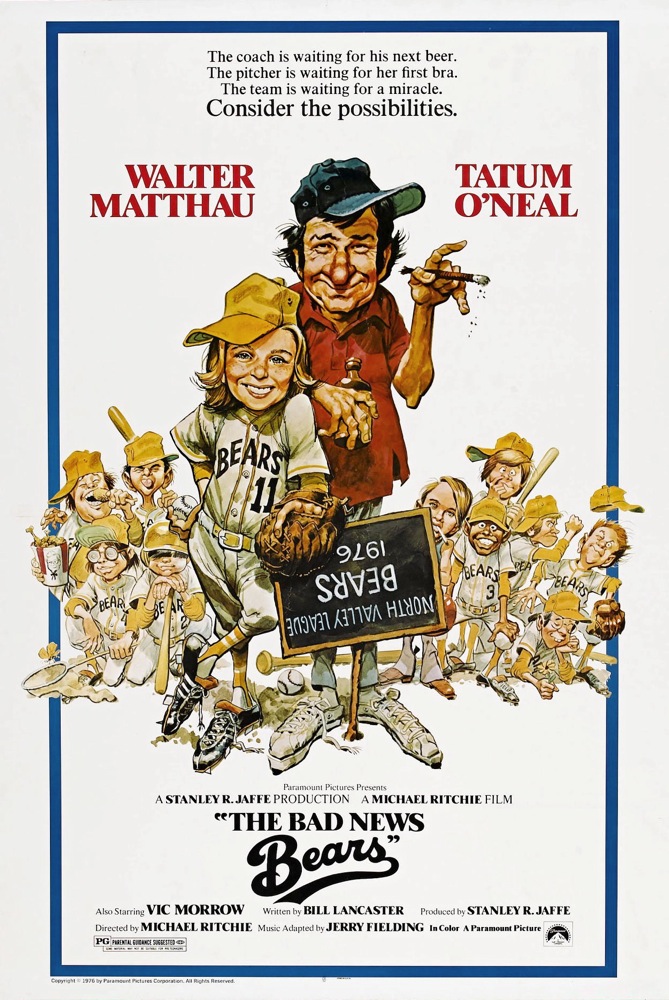
The Bad News Bears (1976) & The Bad News Bears in Breaking Training (1977) & The Bad News Bears Go to Japan (1978)


          Foul-mouthed and politically incorrect, The Bad News Bearspresents a startlingly funny vision of childhood. In fact, it would be nearly impossible to include some of the movie’s edgier jokes in a contemporary film, and that’s a shame—screenwriter Bill Lancaster and director Michael Ritchie lend believable spark to their story by showing characters trading cruel epithets about disability and race. This warts-and-all approach elevates The Bad News Bears from being just another underdog tale in the classic sports-movie tradition; the movie is also a wicked look at growing up the hard way.
          The main adult character is Morris Buttermaker (Walter Matthau), a former minor-league player now gone to seed—he’s a rumpled drunk who works as a pool cleaner in Southern California. Buttermaker gets recruited to coach a newly formed Little League team, the Bears, which comprises rejects from other squads: bad seeds, minorities, nerds, runts, slobs. A paragon of insensitivity, Buttermaker is the worst possible person to corral this gang, since he’s as appalled by these losers as everyone else. To give the team a remote chance of success, Buttermaker enlists a pair of ringers.
          First up is 12-year-old pitcher Amanda Whurlizer (Tatum O’Neal), whose mother used to date Buttermaker. She’s a wise-beyond-her-years handful, demanding endless financial perks in exchange for participating. Next, Buttermaker woos Kelly Leak (Jackie Earle Haley), a local dropout who zooms around town on a Harley and makes a sketchy living with small-time scams. Watching the younger kids get schooled by the self-serving Amanda and Kelly is hilarious, especially since Buttermaker observes the whole pathetic spectacle with a mix of cynical detachment and whatever-works ruthlessness.
          The contrivance, of course, is that Buttermaker falls in love with the team because of how hard the kids try to please him, but Matthau’s unsentimental performance sells the illusion nicely. Better still, Ritchie does an amazing job with the ballpark scenes, using the strains of Bizet’s “Carmen” as a leitmotif for the Bears’ outfield ineptitude; these scenes are sly ballets of expertly staged physical comedy. Ritchie also pays careful attention to vignettes taking place off the field, ensuring that even minor characters are sketched beautifully.
          It helps a great deal that O’Neal was in the midst of her hot streak of precocious performances, and that Haley, in his breakout role, presented a memorable mixture of bravado and insecurity. Even the movie’s main villain, the super-competitive coach (Vic Morrow) of an opposing team, comes across as a fully realized individual, since the dynamic he shares with his long-suffering son speaks to the movie’s theme of what happens when winning eclipses other priorities.
          Predictably, the departure of key players behind and in front of the camera led to diminishing returns for the movie’s first sequel, The Bad News Bears in Breaking Training. Written by Paul Brickman (who later wrote and directed Risky Business), Breaking Training is enervated and overly sweet but basically palatable. The story focuses on Kelly (still played by Haley) and his estranged dad, Mike (William Devane), who takes over as the Bears’ coach. Mike tries to rally the team for a big exhibition game at the Houston Astrodome, and a combination of formulaic plot elements and unwelcome sentimentality makes Breaking Training feel second-rate. Wasn’t eschewing the cheap emotionalism of traditional sports movies the point of the original film? Still, the interplay between the misfit kids, most of whom are played by the same actors, remains enjoyable, so group scenes are fun to watch.
          In fact, Breaking Training is a near-masterpiece compared to the final theatrical film of the original series, The Bad News Bears Go to Japan. Although original screenwriter Bill Lancaster returned for this entry, the gimmick of the Bears getting exploited by a slick promoter (Tony Curtis) feels forced, as does the uninteresting romantic subplot involving Kelly (once more played by Haley) and a pretty Japanese teenager. Even the game-time jokes start to feel tired by this point, so Japan is to be avoided by those who wish to leave their memories of the first picture untouched. The franchise soldiered on when CBS broadcast one season of a Bad News Bears TV series in 1979–1980, with Jack Warden playing Matthau’s old role of Morris Buttermaker. Then, in 2005, the Bears returned for director Richard Linklater’s pointless remake of the original film, with Billy Bob Thornton becoming the third actor to play Buttermaker.

The Bad News Bears: RIGHT ON
The Bad News Bears in Breaking Training: FUNKY
The Bad News Bears Go to Japan: LAME