Showing posts with label denholm elliot. Show all posts

Wednesday, July 3, 2013

The Boys from Brazil (1978)


          Novelist Ira Levin came up with some of the kickiest thriller plots of his era, providing the source material for the films Rosemary’s Baby (1967) and The Stepford Wives(1972), as well as for this picture. Levin’s book The Boys from Brazil blended the sci-fi concept of human cloning with themes related to the World War II Holocaust into an entertainingly paranoid fantasy, and an impressive roster of actors and behind-the-camera talents translated the book into one of the great cinematic guilty pleasures of the late ’70s. The movie version of The Boys from Brazil is almost impossible to take seriously, especially because the leading performances are so over the top as to border on camp, but the picture unspools at a ferocious speed while stacking thrills atop thrills. It’s pure escapism. That is, so long as one sets aside the question of whether it was in good taste to predicate a popcorn movie on the murders of six million Jews. (Although, to be fair, The Boys from Brazil can be viewed as a revenge fantasy against one of the Third Reich’s worst real-life monsters.)
          Anyway, the story begins in Paraguay, where a resourceful young American Jew, Barry Kohler (Steve Guttenberg), tracks down several Nazi war criminals living in exile and stumbles across a conference during which infamous Nazi surgeon Joseph Mengele (Gregory Peck) outlines a plan to murder nearly 100 seemingly innocuous 65-year-old men living throughout the world. Barry transmits his initial findings to Ezra Lieberman (Laurence Olivier), an aging Nazi hunter based in Austria, who is initially skeptical. Meanwhile, Mengele discovers Barry’s spying and has the young man killed, initiating a cat-and-mouse game—can Mengele execute his evil scheme before Lieberman brings the notorious “Angel of Death” to justice? The Boys from Brazil is an old-fashioned potboiler with a modern-age twist, because it turns out Mengele’s scheme—stop if you don’t already know the details—involves “activating” dozens of clones made from Adolf Hitler’s DNA.
          As directed by Franklin J. Schaffner with his customary elegance, The Boys from Brazilis simultaneously goofier and smarter than the average thriller. The premise is outlandish and Levin’s plotting is mechanical, but individual scenes are sharp and the escalation of tension from start to finish is terrific. Regular Schaffner collaborator Jerry Goldmsith deserves ample credit for jacking up the excitement level with his vivacious music, and cinematographer Henri DecaĆ© lends epic scope with evocative location photography from around the globe. Yet on many levels this one’s about the acting, because the star power in the leading roles is formidable.
          It’s a hoot to see Olivier play the inverse of his character in Marathon Man (1976), which featured the actor as an insane Nazi. Olivier’s acting is way too broad in The Boys from Brazil, from the thick accent to the comical eye rolls, but he’s inarguably fun to watch. Similarly, it’s wild to see beloved leading man Peck play an out-and-out monster. Peck succumbs to the same excesses as his co-star, employing an overdone accent and exaggerated facial expressions, but he too is highly entertaining. Supporting actors lend zest, from the exuberant Guttenberg to cameo players including Denholm Elliot, Bruno Ganz, Uta Hagen, and Rosemary Harris. Plus, the always-watchable James Mason has a tasty featured role as Mengele’s pissy colleague.

The Boys from Brazil: GROOVY

Wednesday, May 22, 2013

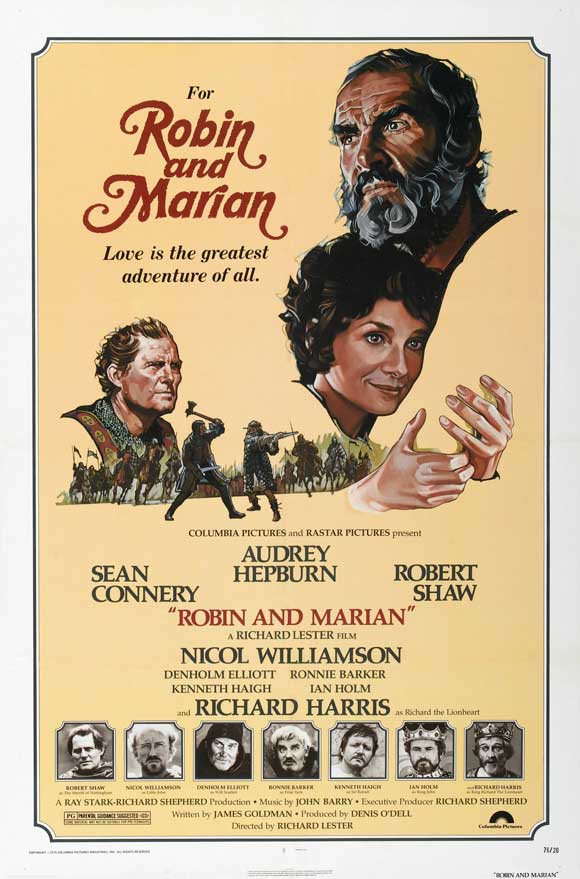
Robin and Marian (1976)


          If you’ve never heard of this romantic fantasy starring Sean Connery as Robin Hood and Audrey Hepburn as Maid Marian, there’s a good reason why—instead of being the light adventure you might expect, Robin and Marian is a tearjerker about aging. Penned by the great playwright/screenwriter James Goldman, best known for his masterpiece The Lion in Winter (which was produced on the stage in 1966 and adapted into a classic 1968 film), Robin and Marianoffers a unique blend of history, mythology, romanticism, and tragedy. From my perspective, this movie is a brilliant reimagining of a beloved fictional character, but chances are the downbeat storyline prevented Robin and Marian from reaching big audiences either during its original release or its home-video afterlife.
          Nonetheless, the movie’s pedigree is singularly impressive. Robin and Marian was directed by Richard Lester, who made the amazing Musketeersmovies of the ’70s and knew how to view swashbuckler iconography through a modernist’s eye; the plaintive score was composed by five-time Oscar winner John Barry, maestro of the sweeping strings; and the film’s naturalistic cinematography was lensed by David Watkin, who shot the aforementioned Musketeers movies and brought the same level of persuasive historical realism to Robin and Marian. Plus, we haven’t even gotten to the supporting cast, which is one of the best ever assembled.
          The story begins in France, where a graying Robin (Connery) and his sidekick, Little John (Nicol Williamson), are soldiers for King Richard the Lion-Heart (Richard Harris). After defying a cruel order from the king, Robin and Little John briefly incur royal enmity—a twist that neatly affirms Robin’s commitment to moral justice over loyalty to any crown. Once extricated from that conundrum, Robin and Little John return to Sherwood Forest, only to discover that the nasty old Sheriff of Nottingham (Robert Shaw) is making trouble again. Meanwhile, Robin tracks down his estranged lover, Marian (Hepburn), who has become a nun. As the story unfolds, Robin falls into open combat with the Sheriff’s men and tries to rekindle his love affair with Marian.
          Goldman’s script cleverly defines Robin Hood as someone who either bravely faces conflict or recklessly instigates conflict, if not both. In so doing, Goldman underlines why a man like Robin expects a hero’s death—it’s the only fitting capstone for a hero’s life. Further, Goldman’s treatment of aging defines Robin and Marian as a grown-up fable; the movie is filled with funny/sad images like that of Robin and the Sheriff huffing and puffing through their climactic duel. Yet the graceful aspects of time’s passage become evident in quiet scenes between Robin and Marian—with the wisdom of age, the characters gain the sure knowledge that they are the loves of each other’s lives.
          Connery gives one of his finest performances, undercutting his 007 image by playing the role with a balding scalp and a thick gray beard. On a deeper level, the actor summons more emotional nuance here than in almost any other film. Hepburn, who ended an eight-year screen hiatus to appear in Robin and Marian, capitalizes on her screen persona to equally strong effect—seeing the dewy gamine of the ’60s replaced by the mature beauty of the ’70s is a bittersweet experience. She’s majestic here. And, of course, to say that Harris, Shaw, Williamson, and fellow supporting players Denholm Elliot and Ian Holm are all terrific should come as no surprise. Robin and Marian is not for everyone, with its occasionally flowery dialogue and perpetually grim subtext, but for this particular viewer (and, I hope, many others), it’s a high order of elgiac poetry.

Robin and Marian: RIGHT ON

Monday, April 22, 2013

To the Devil . . . a Daughter (1976)


It was probably inevitable that the folks at Hammer Films would produce a movie in the vein of Rosemary’s Baby (1968), because nothing screams Hammer like the lurid intersection of sex and supernatural thrills. Unfortunately, To the Devil . . . A Daughter lacks the comic-book fun of the best Hammer flicks—it’s a ploddingly serious psychodrama hampered by indifferent leading performances. And because certain scenes push the boundaries of good taste in terms of displaying nubile flesh, the whole endeavor feels needlessly sleazy. Therefore, even though director Peter Sykes mounts a generally handsome production, with sleek camerawork by the great David Watkin and several atmospheric locations, the cons outweigh the pros. Richard Widmark stars as John Verney, a supernatural expert recruited by worried dad Henry Beddows (Denholm Elliot) to look after Henry’s teenaged daughter, Catherine (Nastassja Kinski), who has spent years cloistered with a mysterious religious organization in Europe. Long story short, it turns out the head of the organization, Father Michael Rayner (Christopher Lee), is a Satanist grooming Catherine for some sort of unholy union with a demon. Verney attempts to save Catherine. The saucy plot could have worked, but Widmark seems so bored that he sucks the life out of every scene he’s in, while Lee—as always, more interesting as a physical presence than as an actor—merely glowers like he’s making one of his interchangeable Dracula movies. In the absence of dynamic leading performances, all eyes turn to Kinski’s exotic beauty. Had she been cast as an innocent whose sexual power was merely implied, Kinski could have justified the movie’s existence with her innately beguiling qualities. Instead, the filmmakers went too far and displayed the actress fully nude, despite the fact that she was a minor at the time of filming. Toying with the erotic implications of a provocative story is one thing, but brazenly showcasing a child as a sex object is putrid.

To the Devil . . . a Daughter: LAME

Wednesday, January 16, 2013

Too Late the Hero (1970)


          After making an influential and popular World War II action picture, The Dirty Dozen (1967), it was inevitable that eclectic filmmaker Robert Aldrich would return to the milieu, and almost just as inevitable that his foll0w-up picture would fall short of the high bar set by its predecessor. While Too Late the Hero features the same muscular combination of provocative drama and slick production values that made The Dirty Dozen so vital, Too Late the Hero suffers from a diffuse storyline and a padded running time, to say nothing of an ineffectual leading performance. So, although the picture is more or less watchable, even if one is tempted to hit the fast-forward button during repetitive sequences, Too Late the Hero fails to make much of an impression.
          Cliff Robertson stars as Lt. Lawson, an American junior officer whose assignment as a command-center translator in the Pacific theater keeps him away from combat. The cushy gig doesn’t last, however, because Lawson gets reassigned to a British commando unit tasked with taking out a Japanese radio installation. Serving under uptight Capt. Hornsby (Denholm Elliot), Lawson and his new comrades trudge through dense jungle, avoiding Japanese patrols, until a series of skirmishes change their circumstances for the worse. Eventually, Lawson and a snarky British enlisted man, Hearne (Michael Caine), inherit responsibility for completing the mission, forcing the unlikely predicament of Lawson becoming a valiant leader. The idea of the movie is strong—exploring the question of whether heroes are born or made—but the execution is not.
          Aldrich, who also co-wrote the picture, lets the narrative drag through unnecessary sequences (there are lots of marching montages), and his contrivance of a combat-averse protagonist means the main character spends a great deal of time watching other people do interesting things. Exacerbating the problem, Robertson simply isn’t expressive enough here to make Lawson’s journey fascinating—in fact, both Caine and Elliot upstage Robertston whenever the British actors share screen time with their American leading man. Caine is largely underused until the last stretch of the picture, when his acidic line deliveries become meaningful on a story level, and Elliot actually comes off the best of the three by portraying a stalwart man whose desire to demonstrate bravery leads him to take foolish risks.

Too Late the Hero: FUNKY