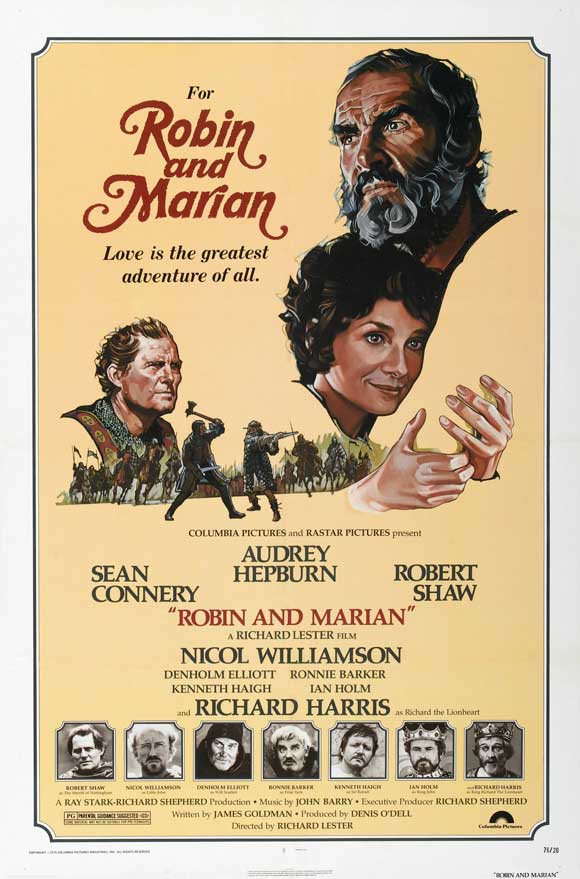
If you’ve never heard of this romantic fantasy starring Sean Connery as Robin Hood and Audrey Hepburn as Maid Marian, there’s a good reason why—instead of being the light adventure you might expect, Robin and Marian is a tearjerker about aging. Penned by the great playwright/screenwriter James Goldman, best known for his masterpiece The Lion in Winter (which was produced on the stage in 1966 and adapted into a classic 1968 film), Robin and Marianoffers a unique blend of history, mythology, romanticism, and tragedy. From my perspective, this movie is a brilliant reimagining of a beloved fictional character, but chances are the downbeat storyline prevented Robin and Marian from reaching big audiences either during its original release or its home-video afterlife.
Nonetheless, the movie’s pedigree is singularly impressive. Robin and Marian was directed by Richard Lester, who made the amazing Musketeersmovies of the ’70s and knew how to view swashbuckler iconography through a modernist’s eye; the plaintive score was composed by five-time Oscar winner John Barry, maestro of the sweeping strings; and the film’s naturalistic cinematography was lensed by David Watkin, who shot the aforementioned Musketeers movies and brought the same level of persuasive historical realism to Robin and Marian. Plus, we haven’t even gotten to the supporting cast, which is one of the best ever assembled.
The story begins in France, where a graying Robin (Connery) and his sidekick, Little John (Nicol Williamson), are soldiers for King Richard the Lion-Heart (Richard Harris). After defying a cruel order from the king, Robin and Little John briefly incur royal enmity—a twist that neatly affirms Robin’s commitment to moral justice over loyalty to any crown. Once extricated from that conundrum, Robin and Little John return to Sherwood Forest, only to discover that the nasty old Sheriff of Nottingham (Robert Shaw) is making trouble again. Meanwhile, Robin tracks down his estranged lover, Marian (Hepburn), who has become a nun. As the story unfolds, Robin falls into open combat with the Sheriff’s men and tries to rekindle his love affair with Marian.
Goldman’s script cleverly defines Robin Hood as someone who either bravely faces conflict or recklessly instigates conflict, if not both. In so doing, Goldman underlines why a man like Robin expects a hero’s death—it’s the only fitting capstone for a hero’s life. Further, Goldman’s treatment of aging defines Robin and Marian as a grown-up fable; the movie is filled with funny/sad images like that of Robin and the Sheriff huffing and puffing through their climactic duel. Yet the graceful aspects of time’s passage become evident in quiet scenes between Robin and Marian—with the wisdom of age, the characters gain the sure knowledge that they are the loves of each other’s lives.
Connery gives one of his finest performances, undercutting his 007 image by playing the role with a balding scalp and a thick gray beard. On a deeper level, the actor summons more emotional nuance here than in almost any other film. Hepburn, who ended an eight-year screen hiatus to appear in Robin and Marian, capitalizes on her screen persona to equally strong effect—seeing the dewy gamine of the ’60s replaced by the mature beauty of the ’70s is a bittersweet experience. She’s majestic here. And, of course, to say that Harris, Shaw, Williamson, and fellow supporting players Denholm Elliot and Ian Holm are all terrific should come as no surprise. Robin and Marian is not for everyone, with its occasionally flowery dialogue and perpetually grim subtext, but for this particular viewer (and, I hope, many others), it’s a high order of elgiac poetry.
Robin and Marian: RIGHT ON

