Showing posts with label susan sarandon. Show all posts

Friday, August 23, 2013

Joe (1970)


          Capturing the anger and confusion of a historical moment when the “generation gap” was at its widest—the dawn of the 1970s—Joeis an unquestionably powerful film. That doesn’t necessarily mean it’s a goodfilm. The narrative is awkward and contrived, the title character doesn’t make his entrance until the 27-minute mark, and the infamous ending is predicated on a silly plot twist. So to characterize Joe as an incendiary statement would be to overreach considerably. Nonetheless, there are good reasons why the picture enjoyed substantial box-office success during its original release, and why it has retained some degree of notoriety since then. Written by Norman Wexler, Joe is about a middle-aged New York ad executive named Bill Compton (Dennis Patrick), who has become estranged from his twentysomething daughter, Melissa (played by Susan Sarandon in her debut film appearance).
          Living with a drug dealer in a grimy Greenwich Village flat, Melissa is a counterculture idealist who’s gotten dragged into her boyfriend’s dangerous world. When Melissa ends up hospitalized after an overdose, Bill tracks down and kills the boyfriend. Rattled after the crime, Bill stumbles into a dive bar where Joe Curran (Peter Boyle) is giving a drunken monologue blaming all of society’s problems on hippies and minorities (“Forty-two percent of all liberals are queer, that’s a fact!”). In one of the film’s least believable moments, Bill confesses his crime to Joe. Thus begins an unlikely odyssey during which Joe leverages the dirt he’s got on his new “friend” to force his way into Bill’s rarified world. Later, when Melissa flees from the hospital, Bill and Joe search for her in the drug underworld, a quest that culminates in an orgy where compliant hippie chicks service Bill and Joe while the ladies’ longhair boyfriends steal personal items from the “straights.” Revenge follows, as does tragic irony.
          As directed by the capable John G. Avildsen, who found tremendous success a few years later with Rocky (1976), Joe is probably a better-made film than the sketchy storyline deserves. The acting is uniformly good, with Boyle the obvious standout as a lout given license by circumstance to manifest his latent psychosis, and Avildsen does a fine job of defining spaces, from the crisp perfection of Bill’s Central Park apartment to the dirty chaos of hippie flophouses. But the story simply doesn’t work as anything except cheap provocation. It’s never totally clear what Joe wants from Bill, or why Bill tolerates Joe’s threatening proximity, and the idea that these two men eventually form true friendship stretches credibility to the breaking point. Worse, the Melissa character exists merely as a set-up for the ending, which doesn’t resonate anywhere near as strongly as the filmmakers presumably hoped it might have.

Joe: FUNKY

Wednesday, July 24, 2013

Checkered Flag or Crash (1977)


This car-race picture comes awfully close to qualifying as entertainment, but dodgy editing and vapid storytelling eventually become so distracting that it’s hard to classify Checkered Flag or Crashas anything other than a dud. Set in the Philippines, the movie depicts a 1,000-mile road race that attracts sportsmen driving cars, dune buggies, and motorcycles. Part demolition derby, part endurance test, and part speed trial, the race scenario offers great potential for action, comedy, and drama. Alas, writer Michael Allin and director Alan Gibson mostly substitute shots of cars driving through dirt patches and thick jungles for actual cinematic content. Joe Don Baker stars as champion driver “Walkaway” Madden, a bearish American, and Susan Sarandon costars as C.C. Wainwright, a car-magazine reporter who rides shotgun in Madden’s rig during the race. The other significant characters are Bo Cochran (Larry Hagman), the race’s good-ol’-boy organizer, and “Doc” Pyle (Alan Vint), Madden’s ex-partner and a rival driver. The movie largely comprises so-so racing footage, interspersed with cutesy romantic-banter scenes involving Baker and Sarandon. While both actors display their considerable innate charm, there’s no chemistry between them, and the characters are underdeveloped to the point of barely existing. Furthermore, there’s no tension in the movie, since Madden’s first-place finish is never in doubt. (After all, most of the other drivers are portrayed as losers and/or nincompoops.) The picture has decent production values, but these don’t count for much because the shooting and cutting of racing scenes is sloppy—camera angles are so close that it’s hard to distinguish details, and the editing relies on blur shots for connective tissue. Considering that Checkered Flag or Crash is a race movie, the presence of substandard racing footage pretty much scotches the whole deal. Yet the movie’s most galling element, by far, is the atrocious music score, which has a cornpone Nashville-meets-Vegas quality. Some of the cues seem pulled from old Hee-Haw sketches, and the title song is the worst kind of truckstop earworm.

Checkered Flag or Crash: LAME

Tuesday, April 2, 2013

The Great Waldo Pepper (1975)


          Director George Roy Hill was such a fervent airplane enthusiast that he persuaded two of his most acclaimed collaborators, screenwriter William Goldman and star Robert Redford, to join him in making this passion project celebrating the daredevils who flew biplanes at exhibitions across the country during the barnstorming era. (The trio’s previous joint venture, released in 1969, was a little something called Butch Cassidy and the Sundance Kid.) Set in the 1920s, the picture focuses on Waldo Pepper (Redford), a World War I veteran whose military service was unspectacular. Driven to prove he’s a world-class flyer, Pepper becomes a barnstormer, performing wild stunts for spectacle-hungry crowds that are equally thrilled by crashes and triumphs.
          During this early stretch of the film, when Pepper builds a friendship with fellow flyer Axel Olsson (Bo Svenson) and struggles through a fraught romance with Maude (Margot Kidder)—who hates the risks Waldo takes—Hill achieves two impressive storytelling feats. First and most obviously, he captures the joy of flight with terrific aerial photography. Secondly and more subtly, he captures the lonely quality of men who follow an inner call toward personal achievement. Redford is the perfect actor for communicating this notion; an iconoclast who has spent decades cultivating personal mystique, Redford understands self-definition.
          Considering that Hill could easily have translated his fascination with barnstorming into a lightweight adventure film—in addition to Butch Cassidy, he and Redford made the endearing 1973 romp The Sting (which was not written by Goldman), so frothy entertainment is undoubtedly what audiences expected from this particular paring of actor and star—it’s impressive that Hill elected to go so dark. In fact, some might argue he went too dark. Goldman has often told the story of how a preview audience turned on the movie during a shocking scene involving Pepper and a terrified, wing-walking stuntwoman (Susan Sarandon). Yet viewed beyond the context of its initial release, when audiences wanted Redford to play only golden gods, The Great Waldo Pepper is a nuanced and thoughtful film that unflinchingly depicts the costs of individualism.
          As the story progresses, for instance, Pepper endures a string of accidents that cost him his pilot’s license and force him to pursue work as a movie stuntman under an alias. Goldman’s writing excels in this last movement of the picture, since Goldman has often said the theme that touches him most is “stupid courage”—boldness in the face of certain doom. The Great Waldo Pepper isn’t a perfect picture, with some of its episodes connecting more strongly than others, but it’s a unique celebration of one filmmaker’s romantic visions, seen through the prism of a star and a writer who were eager to help their friend realize his dreams of soaring through the sky, cinematically speaking.

The Great Waldo Pepper: RIGHT ON

Thursday, January 17, 2013

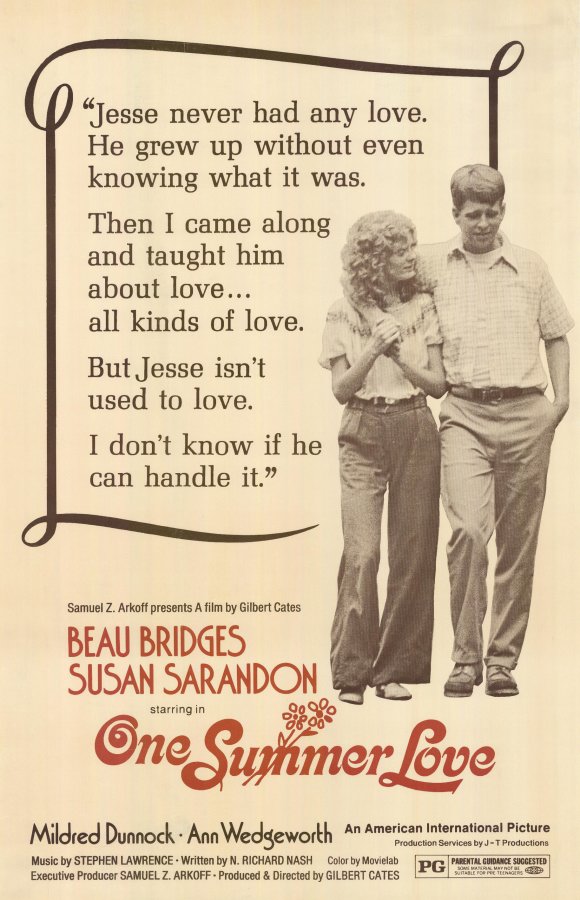
One Summer Love (1976)


         Originally released under the title Dragonfly, this offbeat story depicts the unexpected circumstance by which romance helps a troubled individual recover from psychological trauma—and though the film obviously means well, major problems with character development undercut the intended impact. Beau Bridges plays Jesse, a tightly wound young man who has spent most of his life in a mental hospital. When the picture begins, he receives permission to exit the facility, though his doctor (James Noble) wonders whether Jesse will be able to handle the harshness of the outside world. Intent on finding the family that abandoned him after a mysterious childhood incident, Jesse treks to his hometown of Danbury, Connecticut, and, eventually, enters a movie theater. The theater’s pretty candy-counter clerk, Chloe (Susan Sarandon), discovers that Jesse has no place to stay, so she invites him home even though he’s clearly unwell.
          This single moment virtually undoes the entire movie, because it makes no sense that Chloe would take in a man whom she has already seen manifest symptoms of instability and volatility. Even the tender/tough dynamism of Sarandon’s performance isn’t enough to sell the story’s central contrivance, and producer-director Gilbert Cates—who often thrived telling stories about people with emotional problems—makes several tonal missteps, not least of which is scoring the movie with music so dark that One Summer Love occasionally feels like a horror picture. Unfortunately, Bridges’ performance hurts credibility, too; while he approaches individual scenes with appropriate levels of intensity and/or warmth, he’s unable to overcome the falseness of a character who lashes out in rage whenever it’s narratively convenient for such a thing to happen.
          The weakest section of the picture, however, involves Jesse seeking lodging with a hotel owner (Ann Wedgeworth) who all but rapes the younger man. If One Summer Love was, in part, meant to be a coming-of-age story, then a physical encounter between Chloe and Jesse would have added more soul to the film. Yet the picture recovers, somewhat, once Jesse finally tracks down family members, even though the movie’s final scene is a puzzler. One Summer Loveisn’t a satisfying movie, by any stretch, but it is worth watching largely for Sarandon’s performance and for the gauzy atmospherics Cates uses to evoke the sleepy rhythms of small-town life. If logic is one of your cinematic priorities, though, take a pass on this one. (Available as part of the MGM Limited Collection on Amazon.com)

One Summer Love: FUNKY