Showing posts with label gilbert cates. Show all posts

Thursday, January 17, 2013

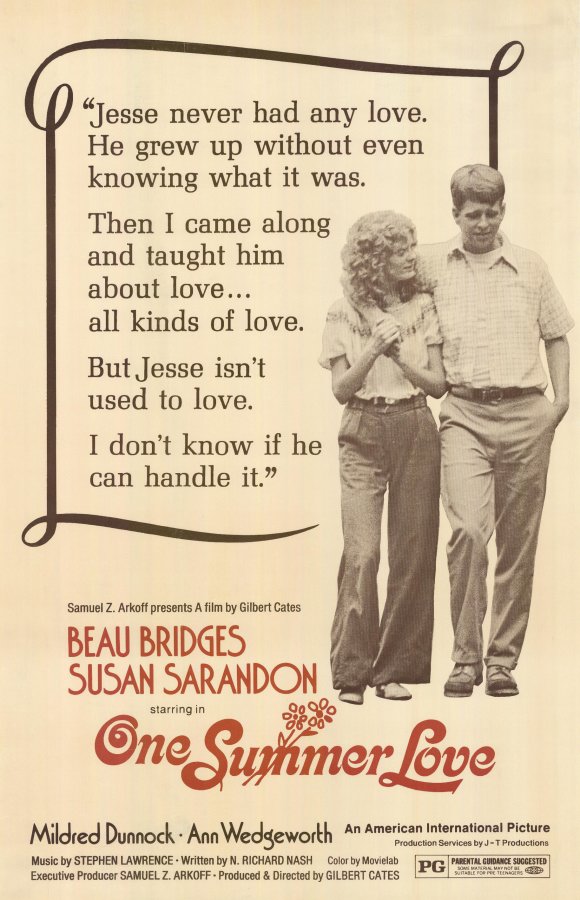
One Summer Love (1976)


         Originally released under the title Dragonfly, this offbeat story depicts the unexpected circumstance by which romance helps a troubled individual recover from psychological trauma—and though the film obviously means well, major problems with character development undercut the intended impact. Beau Bridges plays Jesse, a tightly wound young man who has spent most of his life in a mental hospital. When the picture begins, he receives permission to exit the facility, though his doctor (James Noble) wonders whether Jesse will be able to handle the harshness of the outside world. Intent on finding the family that abandoned him after a mysterious childhood incident, Jesse treks to his hometown of Danbury, Connecticut, and, eventually, enters a movie theater. The theater’s pretty candy-counter clerk, Chloe (Susan Sarandon), discovers that Jesse has no place to stay, so she invites him home even though he’s clearly unwell.
          This single moment virtually undoes the entire movie, because it makes no sense that Chloe would take in a man whom she has already seen manifest symptoms of instability and volatility. Even the tender/tough dynamism of Sarandon’s performance isn’t enough to sell the story’s central contrivance, and producer-director Gilbert Cates—who often thrived telling stories about people with emotional problems—makes several tonal missteps, not least of which is scoring the movie with music so dark that One Summer Love occasionally feels like a horror picture. Unfortunately, Bridges’ performance hurts credibility, too; while he approaches individual scenes with appropriate levels of intensity and/or warmth, he’s unable to overcome the falseness of a character who lashes out in rage whenever it’s narratively convenient for such a thing to happen.
          The weakest section of the picture, however, involves Jesse seeking lodging with a hotel owner (Ann Wedgeworth) who all but rapes the younger man. If One Summer Love was, in part, meant to be a coming-of-age story, then a physical encounter between Chloe and Jesse would have added more soul to the film. Yet the picture recovers, somewhat, once Jesse finally tracks down family members, even though the movie’s final scene is a puzzler. One Summer Loveisn’t a satisfying movie, by any stretch, but it is worth watching largely for Sarandon’s performance and for the gauzy atmospherics Cates uses to evoke the sleepy rhythms of small-town life. If logic is one of your cinematic priorities, though, take a pass on this one. (Available as part of the MGM Limited Collection on Amazon.com)

One Summer Love: FUNKY

Monday, December 10, 2012

I Never Sang for My Father (1970)


          An elegant, insightful character piece grounded by precise writing and masterful acting, I Never Sang for My Father is one of the best small dramas of the ’70s, and it contains a crucial early performance by Gene Hackman. Already recognized as an extraordinary actor (his memorable supporting turn in 1967’s Bonnie & Clyde earned an Oscar nomination), Hackman was on the verge of becoming a Hollywood leading man, and he commands the screen throughout I Never Sang for My Father with the confidence of a veteran star. Indeed, had established actor Melvyn Douglas not received top billing for this movie, it’s likely Hackman’s well-deserved Oscar nomination for I Never Sang for My Fatherwould have been in the leading-actor category, not the supporting-actor category.
          Such considerations aside, I Never Sang for My Father benefits from Douglas’ expert acting as much as it does from Hackman’s touching work. Hackman plays Gene Garrison, an author and teacher who has never been able to win the approval of his father, Tom (Douglas). A self-made man who rose from a miserable childhood to high achievement, Tom lords over every member of his family, exerting such merciless authority that Gene’s sister, Alice (Estelle Parsons), was excommunicated for the sin of marrying a Jew. Despite Tom’s hard edges, Gene struggles to find kindness in the man, especially after Gene’s mother dies and Tom becomes an aging widower with rapidly diminishing mental capacity. Meanwhile, Gene contemplates a move from the family’s East Coast home base to California, where Gene has a chance to start a new life with his girlfriend, Peggy (Elizabeth Hubbard). Thus, in the aftermath of his mother’s death, Gene becomes the de facto caretaker of his domineering dad, potentially at the cost of a chance for personal happiness.
          Exploring themes of duty, independence, love, and what it means to be a man, screenwriter Robert Anderson—adapting his successful play of the same name—digs deep into his characters, presenting everyone in the movie as a complex individual with warring impulses. For instance, Tom is nurturing and tender with his children until the instant he perceives disobedience, which instantly transforms him into a scornful monster. Similarly, Gene is soulful despite exhibiting faint echoes of his father’s macho stubbornness. That both Douglas and Hackman illustrate such subtle nuances is a testament to their thoughtful work. An even greater testament to their skill is that both actors assiduously avoid playing for cheap sentiment: Every painful moment in I Never Sang for My Father is earned. Producer-director Gilbert Cates, who worked on the Broadway presentation of Anderson’s play, serves the material well with unobtrusive camerawork, and his use of unvarnished locations adds greatly to the movie’s diligent realism. (Available through Columbia Screen Classics via WarnerArchive.com)

I Never Sang for My Father: RIGHT ON